Tuesday, December 23, 2008
Monday, February 25, 2008
Saturday, February 09, 2008
Singapore is Watching
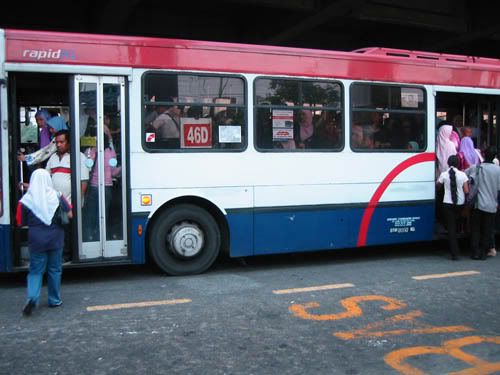
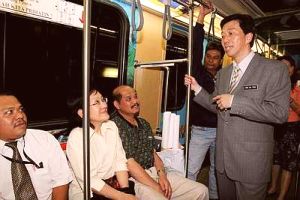
"I am amazed that Malaysians' train courtesy are much better than Singaporeans," he said in an email to STOMP this morning (Feb 4).
The STOMPer said he took this photo during peak hours at a train station and wonders why Singaporeans cannot queue the way the Malaysians do.
"For many years, we are reminded to queue up and give way to passengers coming out of the train.
"To our dismay, not all Singaporeans practise this or bother to show some courtesy."
STOMP
Saturday, January 27, 2007
Thursday, January 11, 2007
Taken the toll
Why good?
- it proves how corrupt the Government is
- it proves how incompetent the Government is
- it proves how evil and heartless the Government and Crony Capitalists are
- driving is still relatively cheap, compared to the amount of environmental damage it cost
- toll rates are going up, not to fix the price distortion, but rather to line the pockets of Umnoputras and greedy Chinese towkays
- public transport still SUCKS, so what kind of alternative is there?
Sign the petition. (not that Kerajaan BN is going to read/care about it anyways)
Tuesday, December 19, 2006
Angry Commuter Indeed
It is less than 2 weeks away to 2007. Visit Malaysia. Plenty of tourists. Plenty of angry tourists.
The TnG has been acting up during my journeys of late too. What a bitch.
Can you imagine if merchants and retailers stopped accepting credit card because “system down”? Or your ATM network goes kaput?
I’ve been quite disappointed to see so little change and improvement in the LRT and buses. I really wonder if the authorities and operators actually care about what we, the real users, think?
Anyway, read this months KLUE.
Wednesday, December 13, 2006
I am still alive
The LRT rubber grip thingies are as smelly as ever.
People still don't queue up when they board the Komuter.
In fact there still exists educated (looking) men (and women) who don't queue up at LRT stations.
Many people still don't understand that "stand on the left to make way for people who want to walk the escalator on the right".
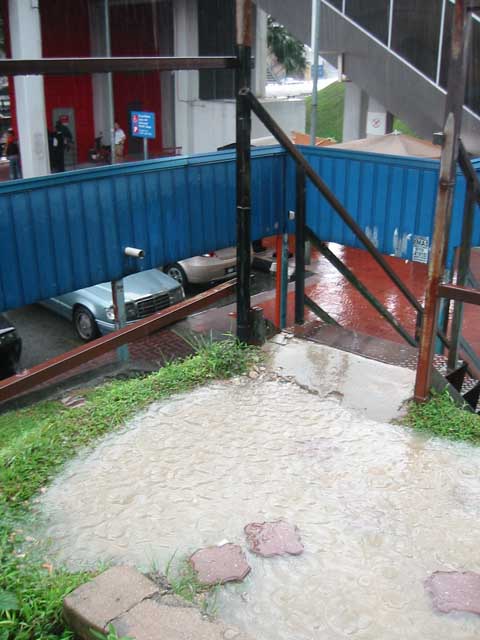
The pedestrian crossing linking Bandaraya LRT to Bank Negara Komuter floods. When it rains.
KL Sentral is still a pasar malam.
Traffic lights in KL don't work for pedestrians. Even when it is RED for road traffic, it still shows RED for pedestrians, even when it is perfectly safe to cross. Screw the traffic lights.
Sigh. Sigh. Sigh. Happy VMY 2007!
Tuesday, November 28, 2006
Perkhidmatan Tergendala
Komuter train service disruptedSo whose fault is it now?
KUALA LUMPUR: The Komuter train service, which connected the city centre to Seremban, Port Klang and Rawang, was disrupted at noon today due to a broken power cable.
The glitch had resulted in trains heading to Port Klang to stop on the track, while trains to the other destinations were delayed.
However, the services have resumed gradually.
“We are working to rectify the situation, and the trains are expected to be running according to schedule later in the day,” said a KTMB official, who declined to be identified.
I hope that there are no court injunctions preventing KTMB from purchasing new cables.
And I'm still waiting for the reports on the zillion Putra LRT failures this year.
Friday, November 17, 2006
Friday, October 27, 2006
Star better than Putra?
Meanwhile, The Sun has reported:
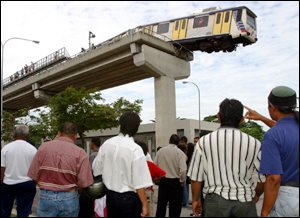
LRT coach overshoots trackA sight to behold! Tsk tsk tsk.
KUALA LUMPUR (October 27, 2006): A Star-LRT coach overshot the concrete embankment at the Sentul Timur station, and dangled about 25 metres above the ground.The incident took place at 7.11am Friday (Oct 27) as the train pulled up at the last stop. There were no passengers in the six coaches then.
Rangkaian Pengangkutan Integrasi Deras Sdn Bhd corporate communications division senior manager Katherine Chew said they are investigating whether the incident was caused by a technical fault or due to human error.
She said their services were operating as usual.
With so many incidences on the Putra LRT, and this amazing/amusing FIRST for Star, I'm, sorry but I cannot offer any useful advice to Rapid KL, SPNB or the authorities. In fact, no amoung of Binafikir-ing can help Rapid KL.
Saturday, October 14, 2006
Uncurb your enthusiasm
I have been pretty busy so I haven't have had much time to think and research about public transportation. So even today's post will be abit substanceless and maybe not directly related to public transportation, although they are still IMPORTANT issues.
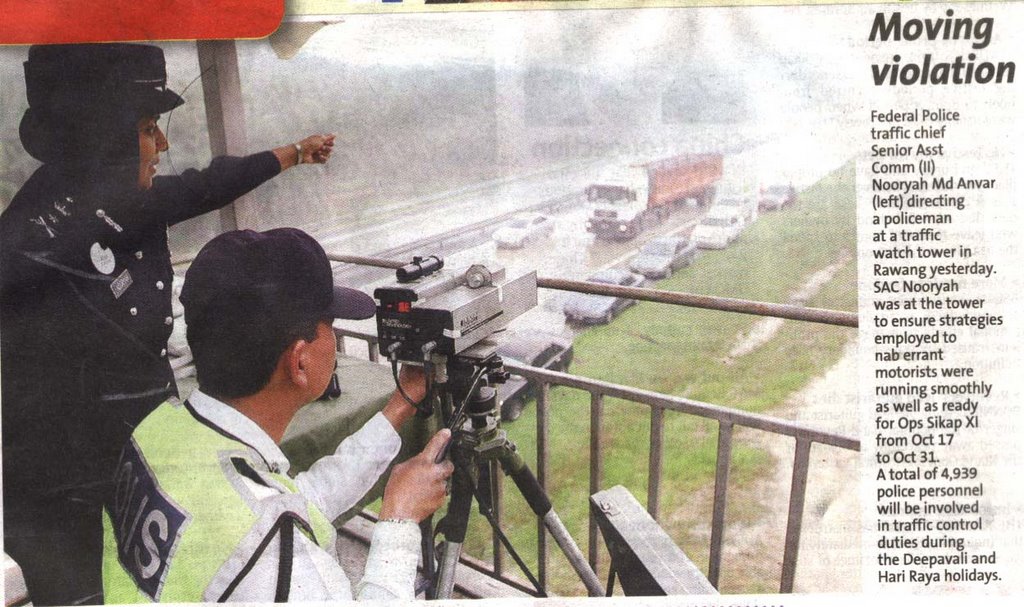
Stationary violation
This was frontpaged in the Star today:

Can you tell me what is wrong in this photo?
See that row of cars parked by the sides? Well that's an emergency lane on a highway. And there's this row of cars, probably driven by the press and the Police. They have themselves committed a traffic offence and have endangered other road users.
The law states it clearly: emergency lanes are for of emergency vehicles and for breakdowns. Even then, it has to be towed away ASAP. If I am not mistaken motorcycles are also allowed to use it.
Regarding the problem then of how and where the journalists were to park, that is not my problem. Reporting a story on road safety doesn't give anyone the license to break the law themselves.
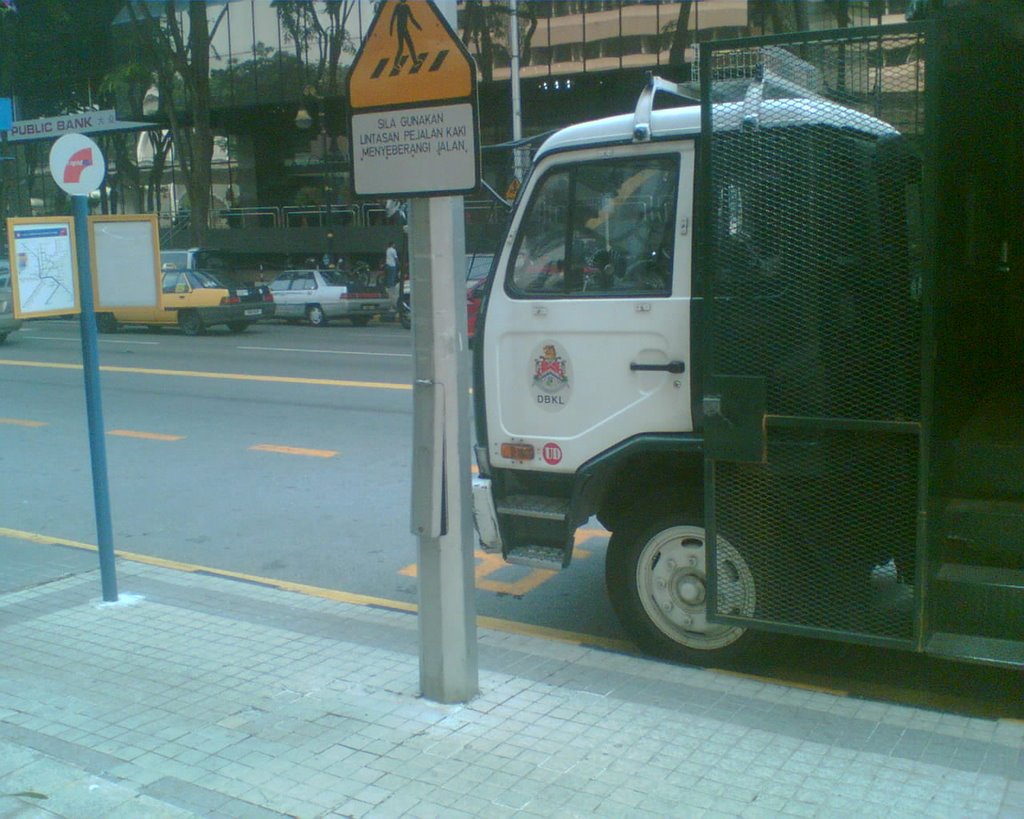
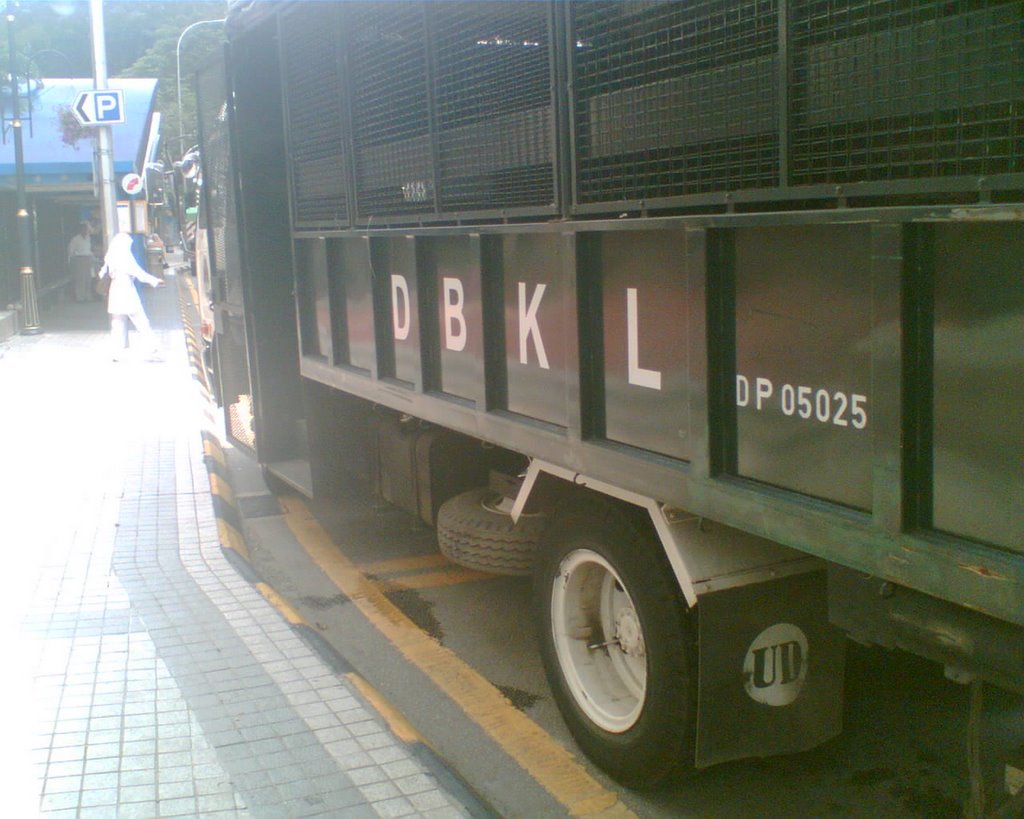
Dewan Bandaraya Kuala Lumpur

Remember the photos sent in by Loke W? Well I submitted it to the Star. I hope the mayor who hasn't been reading his emails reads this today.
Being an officer of the law DOES NOT give you the license to break the law yourself.
Vigilanteism
It's the season once again when the politikus start rambling in the newspapers about crime and "illegal immigrants".
As usual, according to these people, every Indonesian, Burmese and Bangladeshi is a suspect. And they should be sent home (all though no one has thought who is going to replace them, especially the illegals to work in the plantations, factories, restaurants, construction sites etc. that would be Malaysian Idle. You think Malaysians want to do this kind of work?).
And of course, Rela, the citizen vigilante group, is given the carte blanche to arrest some Burmese, beat them up and throw them into a pond.

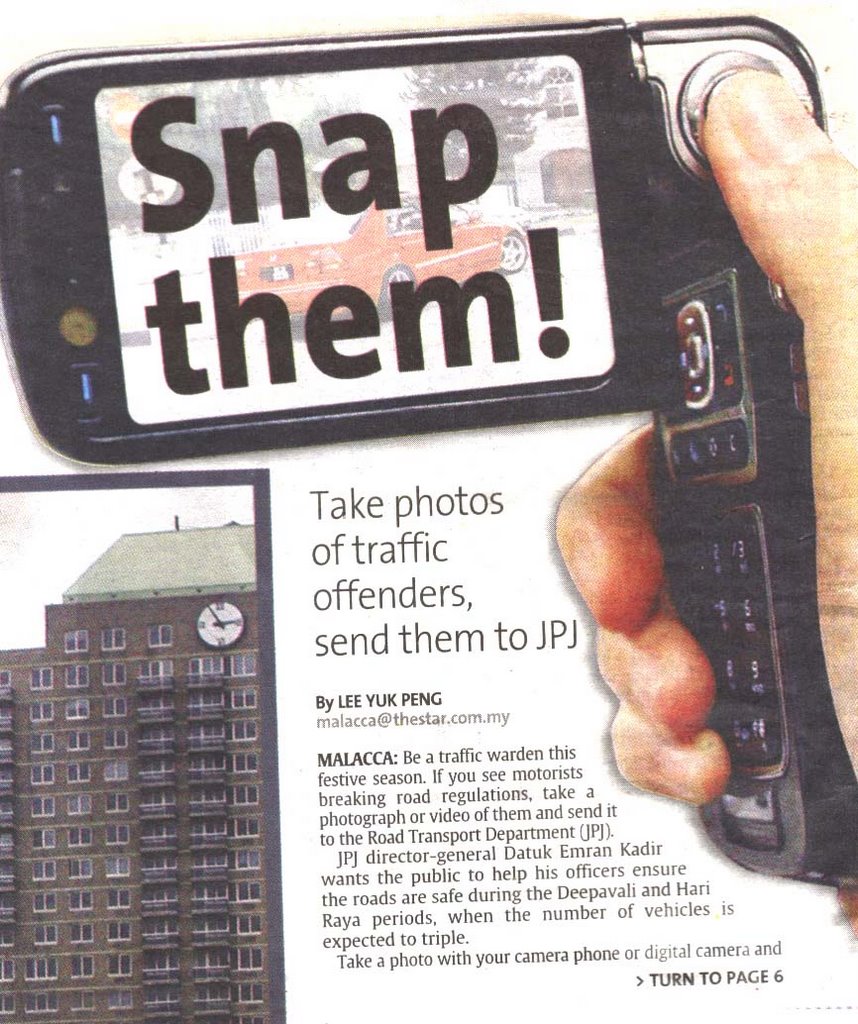
So in the spirit of this season of fear, I encourage you to spy on your fellow citizens for a better cause.
Remember, only use cameras when it is safe. Never when you are the driver (even when you are stationary).
Take photos of all those buggers hogging bus lanes. People cutting in and out. People littering from the car window. People who park in two boxes. People who park in front of fire hydrants.
This beats the hell out of beating people and throwing them into ponds. And even though you are "snitching" and telling on other people, why worry? The Star will black out number plates. And JPJ - what action?
But at any rate, I would still encourage you to submit these photos, with as much information to these people.
- panducermat.org.my/gallery - registration required
- thumbnails@thestar.com.my
- kpjpj@jpj.gov.my
Ever dreamt of being a police officer as a kid!? Well dream no more.
While you're at it, issue a "saman" for the traffic offender. I think it will be quite difficult in most cases to issue it, with the exception of parking offences. Still, it's better than nothing!
In classic ugly formatting and Times New Roman and in A4 size this is almost as real as it can get.

Print this out. Plenty of it. Keep it in your car/bag. Issue it liberally, but please children, don't ask for a bribe.
And remember, don't be a HYPOCRITE like DBKL, The Star and the Police.
Tuesday, October 10, 2006
Transport regulation
I like 2, 3 and 4.I seriously urge the transport minister to make the following sweeping changes:
- Fire Rapid KL’s top management in charge of the Putra LRT. The Putra LRT’s constant failure means failure on their part
- Fine Rapid KL RM1 million for every hour the LRT is down. To be frank, RM1 million/hour is a paltry sum compared to the thousands of human resources stuck on the trains and at the stations when they are supposed to be at work contributing to the country’s economic growth.
- Publicly display to the commuters Putra LRT’s KPI (key performance indicators). Monthly statistics like system failures, late trains, Touch & Go breakdowns, ticketing gate malfunctions, air-conditioning jams in trains and stations would be helpful. And don’t cheat.
We will have a good laugh at the dismal figures initially, but I’m sure Putra LRT will improve the system to save its own face from constant public embarrassment.- Fire those who can’t meet these KPIs.
Regarding 1, that's a little bit more complicated because SPNB is the company that owns the infrastructure. As far as I understand, SPNB owns the trains etc. and thus money for maintenance etc. comes through them.
I have written a little about 2 and 3 here.
But the question I would like to ask is who is KL's transport regulator? Rapid KL is an operator, with quasi regulatory powers (look at how easy it was for them to "revamp" the network"). But someone needs to regulate Rapid KL, no?
To be honest, I have a million things to say about this whole Putra LRT cock ups.
But most of it would be so obvious. And these people, Rein Westra, Ali Nor and Katherine Chew - I'm sure they are reading this blog and all the complaints on the net. But what to do? They inherited many organizations with lousy third world work ethic and culture and a demotivated workforce.
Afterall, in this age and day, what type of right thinking intelligent person would want to be a bus driver or station master?
If you think Malaysia Airlines is bad, and Idris Jala has sleepless nights, can you imagine Rapid KL?
Monday, October 09, 2006
What revamp?
____
This year, Rapid KL has "revamped" the bus system. In my opinion this "revamp" consists of two separate efforts:
Firstly, the network revamp. The Local-Trunk-City-Express system. That is something out of this world to us KL folk. And this is what I believe Rapid KL means by "revamp".
Secondly, fleet revamp - fleet enlargement and upgrade. New buses, more buses, reconditioned old buses. COINCIDENTALLY, these buses were introduced this year. I'm not sure if Rapid KL would have proceeded with effort 1 (network revamp) if there was no fleet revamp.
So, when we praise or criticize this new "system", are we talking about the network revamp or the nice new clean buses (and their relative abundance)?
When discussing this revamp, we have to decompose the effects of the fleet revamp, which would SPNB would have proceeded regardless of Rapid KL's plans to change the network. For example, when doing a survey on "what do you think of this new system", we have to consider:
1. fleet revamp (with plenty of new buses) and network revamp (local-trunk-city-express); vs
2. fleet revamp (with plenty of new buses) without network revamp (old system with all buses terminating at KL or LRT stations at most)
Fleet revamp, is a given, since that is SPNB's mandate, while operationally Rapid KL decides how to utilise that fleet (network).
I don't think Rapid KL has been honest enough in presenting this case that the hub-and-spoke (local-trunk-city-express) is indeed better. As far as I have read, they haven't cited any reasons why this system is better. They just make a claim that hub-and-spoke leads to shorter waiting time without showing the logic or evidence.
http://www.rapidkl.com.my/o
The only plausible reason I can guess is that breaking up longer routes into shorter ones will lead to less accumulated delays. And breaking them up into many independent systems will also avoid problems elsewhere. For example, if there is a big jam at Kotaraya, this shouldn't affect people who wish to travel from Subang to Bangsar. Under the old system it would.
Whether this new network system is indeed better, I think we should let Rapid KL give it a try. But I expect Rapid KL to produce some evidence in a few months showing that indeed time is saved and it is the most effective and efficient (least waste) way of managing the routes.
Another thing that has to be looked at is the new fare structure. How would the issuing of bus passes change people's travelling habits? How about those people who only need to make one trip a day? Probably a lot of people who say that "I love this new system" are coming from people who travel a lot who now experience cheaper fares because now their fares are capped at RM4? Probably true if your sample consists mainly of people in Bangi who travel to KL and would have had to spend more than RM4 before.
At the end of the day, we all have to ask ourselves this - "what does it mean by NEW SYSTEM?"
I expect Rapid KL to be clearer in their communications when praising and advocating this new "system". Is it the new and more buses they are talking about? Or the hub and spoke system? Or the bus pass fare structure?
These are 3 different initiatives by Rapid KL (and SPNB) and Rapid KL has the responsibility in explaining to its stakeholders (government and us users) how each have brought benefits.
No cock and bull about, oh this system is better because waiting time has been cut. (IF AT ALL IT IS TRUE, AND IF TRUE is it because of more buses on the road or is it due to the gains from the hub and spoke?)
Saturday, October 07, 2006
LRT breaks down and Rapid KL dogma
I wasn't and am not around for the weekend, so I only got to know of it through the news.
In this post, I'd like to talk about 2 different but closely related topics.
I'm not sure if they did any of this, but here's what they could have done to ease the pain:
- brief all bus drivers and get them to advise passengers that they may need to take a continuing trunk line instead of to the LRT.
- announce the breakdown on the internet and radio.
- 1-800-number. A friend of mine told me that she called the 1-800 number but it was engaged. Why not just pre-record an announcement about the breakdown and how to go around it?
- fix the problem! this is the number what-th time this year?
- have contingency plans - rail replacement services that bring passengers from one station to another. In fact, why not introduce a trunk line service that tracks the LRT system and have it run during peak hours? The KJ line is so packed that it'd be good to educate passengers in using the bus system. Do one from KL Sentral to Kelana Jaya, and another from KLCC to Gombak. Heavy traffic on the road will ensure that most passengers would still prefer the LRT and hence introducing this route ought not to cannibalize LRT services too much. In fact, run services parallel to all rail lines!
- SMS information to customers. How about doing that to MTC holders for a start?
You see the problem here. Each area is too dependent on one city hub. And when one city hub fails, then problems multiply.
For example, yesterday, where services east of Masjid Jamek were disrupted, train passengers heading towards Wangsa Maju were directed at Masjid Jamek to change lines to Titiwangsa to take continuing Trunk line services. (Again passengers were penalized with "starting fares".)
Instead, a more ideal solution would have been to have trunk line buses serving Wangsa Maju and all (Area 3) from KL Sentral. So passengers could have just got off there to take a trunk to Wangsa Maju, without having to waste time and money walking up the stairs and buying a new ticket or hopping on yet anoter City shuttle to take you to Titiwangsa.
The problem with Rapid KL's system is that it assumes EVERYONE lives in the suburbs and travels to the City everyday. Ok, maybe not everyone. But for the rest of the people who don't, Rapid KL's sorry that if you live in Ampang and you study in Subang Jaya, you have to take 2 trunk lines, a city shuttle and probably another 2 local shuttles. Otherwise take a more expensive LRT (change lines at Jamek including) and hop on another 2 local shuttles.
Or you can drive. If you can't then too bad.
Similarly if you live in USJ and work in Sri Petaling. Live in Taman Desa and work in Cheras. So close and yet so far.
Or if your Indonesian worker who lives in Datuk Keramat (many do) and works in Bangsar, and the LRT breaksdown, how? That's 4 buses. :)
So LRT breakdown? Hop on a bus? How? How many?
Friday, October 06, 2006
One small step for a man, the disabled stay at home
Malaysia is heading for exciting times as the nation celebrates its 50th anniversary of independence next year. Around that time, we will have a cosmonaut in the International Space Station (ISS) as reported in “Russia-bound astronaut candidates inspired after meeting Abdullah” (The Star, September 27, 2006). This puts another feather in the cap to mark our achievements as a maturing nation.Masyarakat Penyayang betul.
While we wait in anticipation for the day one of our own steps into the ISS orbiting 350 km above us, it is ironic that a group of people back home here in on Earth cannot move around conveniently, even for distances a fraction of that to the ISS.
In the haste to improve the public transport system in the Klang Valley, disabled persons are once again left out in the planning. None of the new Rapid KL buses are accessible to wheelchair users. Even senior citizens have problems boarding the buses because of the unfriendly height of its steps.
Disabled persons are disillusioned by empty promises. There was a protest in 1994 when it was apparent that STAR LRT was not accessible. 12 years later, wheelchair users still cannot use the trains because there are no elevators up to the platform, or use any public transport for that matter.
We are beginning to wonder if our needs will ever be addressed. Do we need to resort to staging demonstrations and protests again to get our voices heard? For what it is worth, it is an uphill battle for us all the way and all the time.
What does it take for the government to realise that accessible public transport is an urgent need without which we cannot do much. We have to miss out on education and work opportunities. This makes us even more disadvantaged.
The often heard excuse of not including accessible facilities is the cost factor. How can we put a price on the rights of fellow citizens? Public transport is for all, irrespective of physical condition. The needs of one group must not be at the expense of another. However, in the case of public transport, it looks like the needs of disabled persons are at the lowest of priorities.
As we anxiously wait for the first Malaysian to go into outer space, I urge to government to seriously look into the plight of disabled persons who cannot even get out from their homes. We should not look that far out when we have not even tackled challenges that are right in front of us.
Thursday, October 05, 2006
No Law
Hell, even the people that are paid to enforce the rule of Law break those very same rules.
A very disappointed reader, Loke W, sent me these photos.
These were taken along Jalan Raja Laut today, 5 October 2006, between 9.30 and 11.30 a.m.
Jalan Raja Laut also happens to be Kuala Lumpur City Hall.
There is no Law in KL.

What bus stop?

There is no Law.

What Law?

No law.

Proud to be DBKL!

See the Jalur Gemilang? Get out of my way you mofo.

Blatant disregard of the law.

My car is bigger than yours.

I work for the government. Cekap bersih mesra.

Write me saman I dare you.
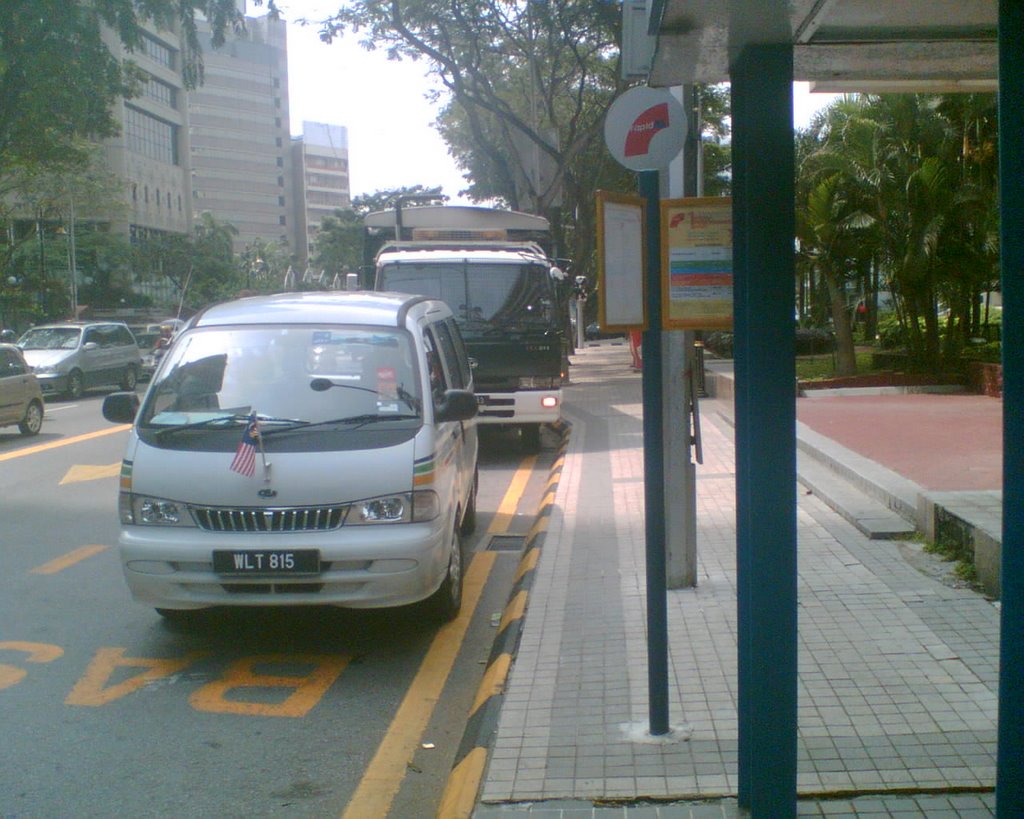
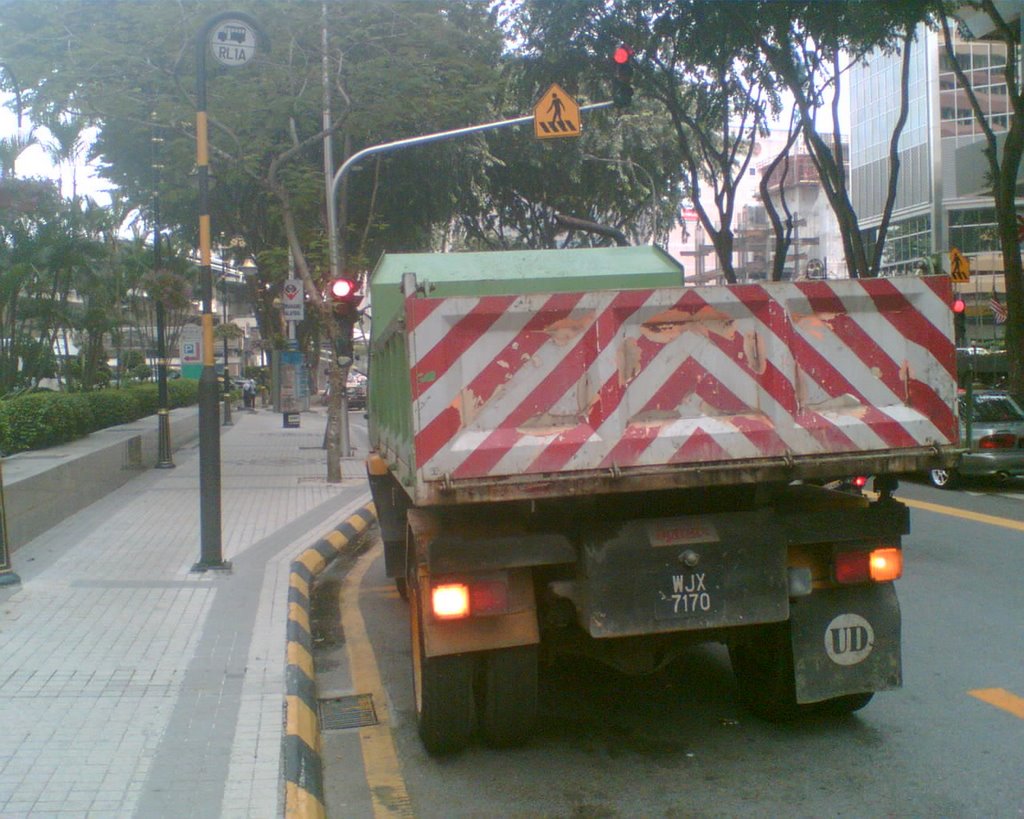
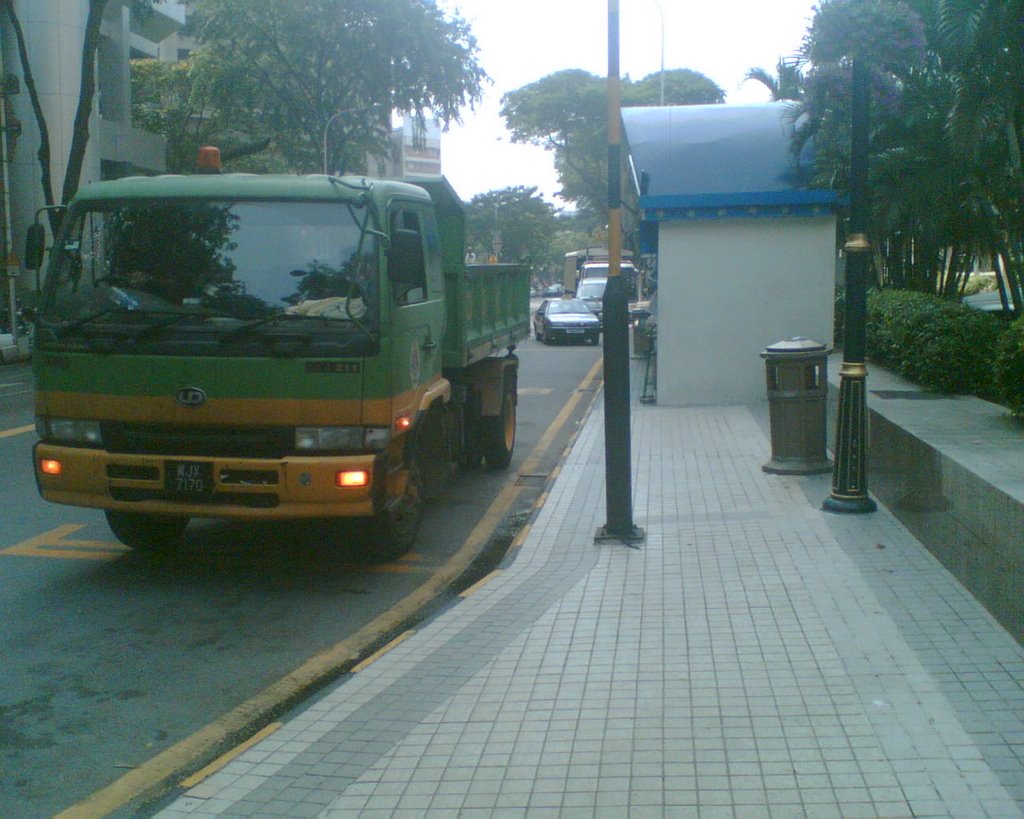
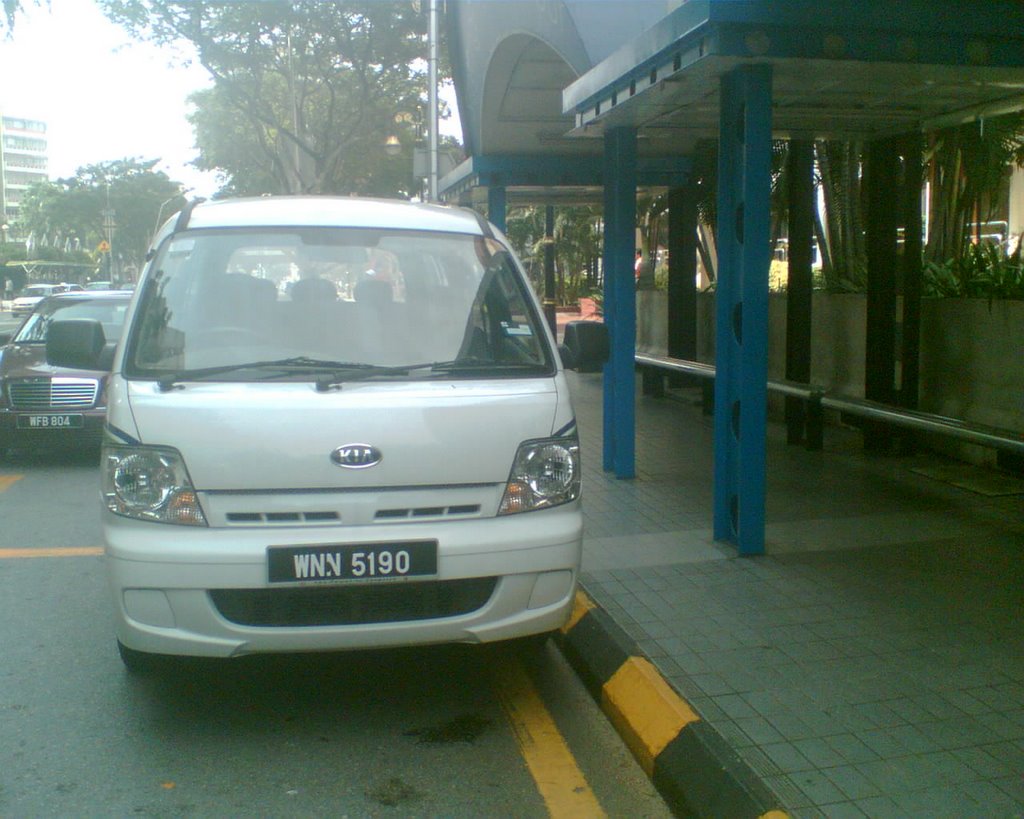
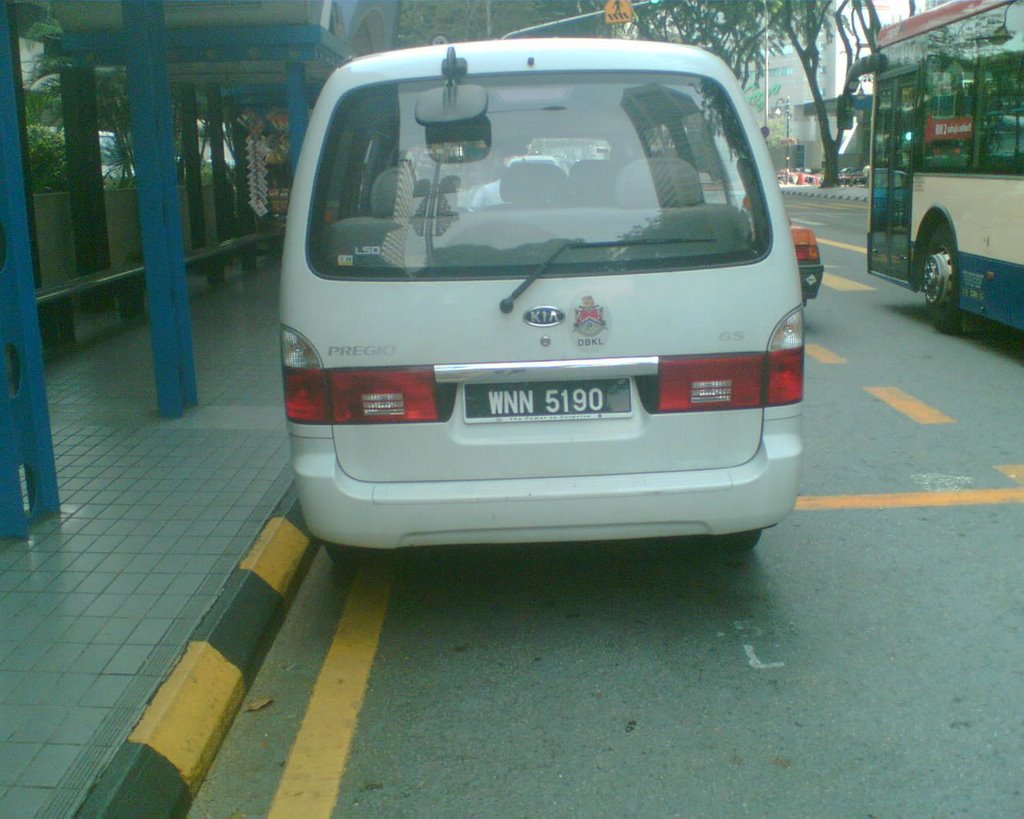
These vehicles, with the DBKL colours and logos splashed all over them were seen and photographed parking illegally at a bus stop and bus lane:
WNN 5190
WJX 7170
WLT 815
WMP 643
WNP 1859
Datuk Bandar, what are you doing?
Meanwhile, when I was passing Jalan Bangsar at around 6 something, a motorcade with police outriders, with the VIP car numbered ACS 1 (I think) rushed his/her way through traffic.
Yes, this VIP is definitely engaged with more important matters than the rest of us earthly scum (a.k.a. the Rakyat Jelata). Like berbuka puasa at Shangri-La perhaps?
Third world mentality. Third world government. Third world politicians.
____
DBKL says this and this:
PENGUATKUASAAN LARANGAN PENGGUNAAN LORONG BAS / TEKSI KEPADA KENDERAAN PERSENDIRIAN / PUBLIC NOTIFICATION
Tarikh : 4 Mac 2005
Polis Trafik Kuala Lumpur dengan kerjasama Dewan Bandaraya Kuala Lumpur akan mula menguatkuasakan peraturan larangan penggunaan lorong bas / teksi oleh kenderaan persendirian pada 7 Mac 2005 (Isnin).
Peraturan larangan penggunaan lorong bas / teksi kepada kenderaan persendirian ini telah diwartakan sejak tahun 1998 di bawah Akta Pengangkutan Jalan 1987 (Pindaan 1988). Ini adalah bagi melancarkan pergerakan kenderaan awam terutama bas dan teksi di pusat bandar. Sehubungan dengan itu, kenderaan persendirian adalah dilarang menggunakan laluan tersebut mulai jam 6.00 pagi hingga 8.00 malam setiap hari bekerja kecuali hari Ahad dan Cuti Am.
Kuala Lumpur Traffic Police and City Hall Enforcement Officers will be on duty on a regular basis to enforce the regulations pertaining to restriction of private vehicles utilizing the dedicated bus lanes in the city from 7th March 2005.
The law pertaining to bus lanes has been gazetted since 1998 to facilitate the movement of buses in the city. The general public, particularly vehicles drivers should comply with the bylaw Road Transport Act 1987 (Amendment 1998). Private vehicles are not permitted to use the bus lanes between 6.00 am till 8.00 pm everyday except on Sundays and public holidays.
Bilakah masa dan hari yang dibenarkan kepada orang awam untuk menggunakan lorong bas?
Hari-hari biasa pada jam 8.00 malam hingga 6.00 pagi.
Hari minggu - sebarang waktu.
Hari Pelepasan Am - sebarang waktu.
Kadar kompaun yang dikenakan kepada pesalah yang menggunakan lorong bas ialah RM300.00.
Of course. DBKL is not "orang awam" and not "kenderaan persendirian".
My Bahasa sucks, but I think the word is munafik.
Tuesday, October 03, 2006
Price discrimination
| Sentral | BTS | Putrajaya | Salak Tinggi | KLIA | |
|---|---|---|---|---|---|
| Sentral | RM4.20 | RM9.50 | RM12.50 | RM35.00 | |
| BTS | RM4.20 | RM5.30 | RM8.30 | RM26.50 | |
| Putrajaya | RM9.50 | RM5.30 | RM3.00 | RM6.20 | |
| Salak Tinggi | RM12.50 | RM8.30 | RM3.00 | RM3.20 | |
| KLIA | RM35.00 | RM26.50 | RM6.20 | RM3.20 |
With too much time to spare, one can ride on the trains for cheap! Although I don't recommend you do it.
I hope that Rapid KL and other train operators can sit together to harmonize train fares (not a cartel please!).
Most importantly is the problem of "starting fares".
Then, there is the enormous potential benefits to routing plenty of traffic from down south into KL via the LRTs and the ERL. Much faster travel. And relieves all the headaches on the KTM lines.
Simple logic. Scrap the KLIA Express (28 vs 36 minutes!?). Currently per hour, 4 trains doing the Express, 2 the Transit. Meaning 6 per hour. Or once every 10 minutes.
Retain check in facilities and other premium KLIA Express frills, but introduce "standard class" by either adding additional rolling stock or ripping out the furnishings/upholstery of one (or two) carriages to make it "standard". More standing room?
On all trains, allow premium services to continue on normal (except scrapping EXPRESS services). Let ERL price these services as ridiculously as they like (like in the table above).
Regulate services on "standard class". How about Rapid KL paying a fixed annual compensation fee for the use of this carriage? Do the same with KTM Komuter, except the Komuter does not have a "premium" category.
Have Rapid KL treat KLIA Transit as a loss leader.
Win-win.
- Consumers - choice is good!
- KTM - less passenger congestion; focus more on operations
- Rapid KL - economies of scope from being able to supply many different types of public transport solutions (e.g. previous KLIA Transit users now able to continue journey in KL using same ticket/pass)
- ERL - minimize business risk i.e. constant flow of income; able to focus more on operational aspects as marketing/ticketing delegated back to Rapid KL
Monday, October 02, 2006
Swimming trunks
Pick up a copy of The Star today, turn to N48 to the Letters to the Editor pages.
Oh bother. I'll just copy the whole thing for you.
RapidKL needs to iron out problemsI'll admit to you. I live in KL, not in the Selangor townships. In fact I live very near a busy main road. And I never need to travel very far to get to work. I never really need to use trunk services very much.I REFER to the letter by Moaz Yusuf (RapidKL on the move, The Star, Sept 26). I wonder whether the writer had taken the bus before writing his comments. I have. (KLC: Ouch!)
I tried taking bus 616 from Kerinchi back to Uptown PJ; the first time I waited for 35 minutes, the second, more than one hour from 4pm and it never came (the stated frequency was 15 minutes). I called the helpline and was told that there would be two buses that day, and “maybe” the delay was caused by traffic jam.
These are some problems with the new system:
lThe design of bus routes: they have applied the LRT interchange concept to the bus system. KL Sentral, Uptown and 1 Utama are the stations for interchange. For instance, if I want to travel from Kota Damansara to KL, I have to take bus 613 to Uptown, then change to bus T82 to KL Sentral, then take another bus there or LRT to KL. Sounds simple? But, every change means another 10-15 minutes wait, or longer!
lThe bus fare: they have divided the buses to two types, green for short distances, (for example, Uptown to Bandar Utama) charging RM1, and blue for main routes (e.g. BU to KL Sentral). All tickets are one day passes which can be used all day long. But, if I travel from BU to Uptown, and buy a RM1 ticket which only the green buses sell, and on my way back should the blue bus comes first, I’ll have to pay another RM2 or, wait.
The bus routes are too complicated: they changed all the previous LRT feeder buses into green buses, and added another 25 bus routes (without having enough buses to provide punctuality). If it took me two days to understand the bus routes, how long will it take the tourists and illiterates?
PHOON H.B.,
Petaling Jaya.
Phoon highlights 3 points. I think I've talked about one.
Point 3, about routes being too complicated, I have talked about the rubbish route information being posted up at places such as here, here, here and here. The people who need to understand the system find route information complicated, and those who don't need to learn the routes are those that would find it easy. Think: spider maps, journey planners, website
Point 1, about accumulated waiting times. IN THEORY, if all the buses are as frequent as claimed, I think the savings in waiting time can be achieved. Afterall, that was the main reasoning behind the revamp, no? Remember, the promise:
He (Rein Westra, CEO) said the local shuttle service will be available every 15 minutes and trunk service at every 10 minutes. He said the public is able to achieve a saving of minimum 10 to 20 minutes with this new network compared to the old.But recently, Rapid KL officially changed some of its service promises. I'm not sure how this would help. Although I think, not at all.
If it is a fleet problem - go and buy more! If it is a shortage of drivers - what the hell is HR doing? If it is a problem of congestion - what happened to bus lane enforcement and talking to Bandaraya etc? And what are your consultants doing?
Point 2, why should I pay trunk fares when I travel short distance? In a nutshell, if you usually take a local shuttle (which costs RM1/day) for a journey and you see a trunk bus which is also heading to where you want to go, why can't I use my local shuttle ticket on the trunk?
(I like you Mr Phoon, because unlike most other people who criticize public transport, you point out the not so obvious. It's not all about buying more buses, adding more bus lanes, lowering fare prices, buying more train coaches la la la.)
This whole scenario points out why I am quite ambivalent about the new bus pass structure, where NO single tickets are issued. With regards to fares, it works pretty nicely IF everyone travels a lot. But for people who travel short distance, they are penalized. Either by the fact that they are making journeys that are worth less than what they have paid. Or because of the silly things that people have to do to make their passes worth it (like in the case Phoon pointed out).
There are many ways to fix this, but this is what I'd suggest (again!):
- Make Touch 'n Go (or other stored value cards) the default payment system. No problem as the MyKad has the TnG embedded anyways. Also sell TnGs at newspaper vendors etc. And try to push for adoption of TnG as a universal payment system, as good as cash in Malaysia.
- Reintroduce single fares and scrap Local/Trunk/City passes.
- Introduce price capping. Once users make enough journeys in a day, card functions as a pass.
- Reintroduce TnG readers at the rear exit of buses so that users touch on the way out, like in Singapore's buses or in the Cityliner. Do this so that Phoon and others can hop on a Trunk bus, make a Local journey and pay Local price.
- Revamp the whole system-wide fare structure as well (including other operators and rail systems included). Abolish "starting fares". The systemwide fare structure needs to be rethought
Sunday, October 01, 2006
Why I am so anti monorail
Note a few things:
- vehicles are generally smaller than other metros, thus higher cost per passenger mile.
- mistakes in switching (changing "tracks") can be fatal - "derailment" being the vehicle falling off the track
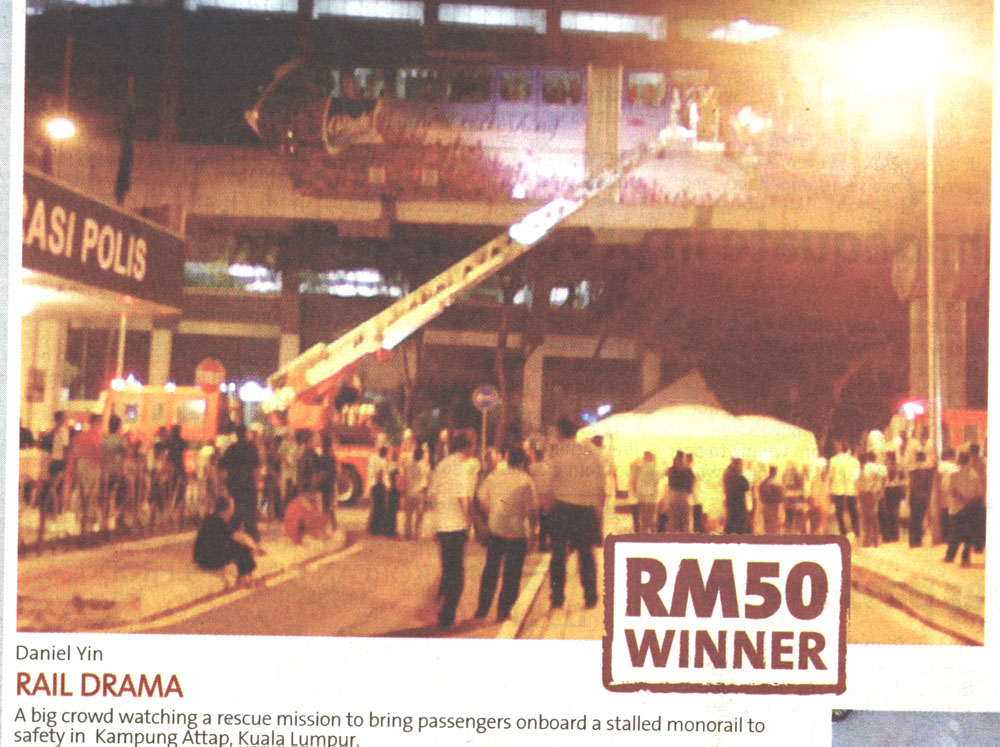
- evacuation problems in emergencies as there are no emergency walkways.
- many other monorail systems in the world are at amusement parks.
What has been built in KL has been built, so no point crying over spilt milk. But I think that there should be NO MORE in KL. The Klang Valley is sprawling. Travelling long distances will take plenty of time, and opportunity to upgrade to Mass Transit standards is limited.
Maybe for Penang and JB, there is a case for it. But there is talk about including a monorail line on the second bridge to Penang.
Which brings up issue 2 and 3. Can you imagine being stuck in malfunctioning vehicle suspended over the open sea?
Saturday, September 30, 2006
Rapid KL breaks promise

The promise...

The proviso...

Well, I've checked out the "updated" Rapid KL and here's something very interesting (apologies for the ugly table which I just copied off the website):
| HEADWAY ON WEEKDAYS ( MONDAY - SATURDAY ) | ||||
DESCRIPTION | PEAK 1 | OFF PEAK 1 | PEAK 2 | OFF PEAK 2 |
06:00 - 09:00 | 09:00 - 17:00 | 17:00 - 21:00 | 21:00 - 24:30 | |
| CITY SHUTTLE | 10 MIN | 15 MIN | 10 MIN | 20 MIN |
| TRUNK LINE | 15 MIN | 20 MIN | 15 MIN | 30 MIN |
| LOCAL SHUTTLE | 15 MIN | 20 MIN | 15 MIN | 30 MIN |
| EXPRESS | 30 MIN | 30 MIN | 30 MIN | 60 MIN |
| HEADWAY ON SUNDAYS AND PUBLIC HOLIDAYS | ||||
DESCRIPTION | TIME | HEADWAY | TIME | HEADWAY |
| CITY SHUTTLE | 06:00 - 21:00 | 10 MIN | 20:00 - 24:30 | 20 MIN |
| TRUNK LINE | 06:00 - 21:00 | 20 MIN | 21:00 - 24:30 | 30 MIN |
| LOCAL SHUTTLE | 06:00 - 21:00 | 20 MIN | 21:00 - 24:30 | 30 MIN |
| EXPRESS | 06:00 - 21:00 | 30 MIN | 21:00 - 24:30 | 60 MIN |
This information can be obtained here and here.
Well, here's what was promised at Rapid's own website
These areas will have new local shuttle services and trunk line service into the hubs in the city linking them into the city via city shuttle services every 5 minutes.The Star on 15 September 2006:
[...]
He said the local shuttle service will be available every 15 minutes and trunk service at every 10 minutes. He said the public is able to achieve a saving of minimum 10 to 20 minutes with this new network compared to the old.
“We need some 250 new buses to serve this new network, with the frequency of a bus every 15 minutes for the local shuttle and 10-minute wait for the trunk service.So it's clear, it was promied 5-10-15 for City-Trunk-Local.“At the moment, we have about 100 new buses and are expecting more to arrive next week,” said Mohd Ali.
And yes, I understand the escape clause "Rapid KL reserves the right to make any changes prior to any notice" (whatever that means) allows Rapid to do that.
If indeed this is true, then it's gonna lose lot's of trust and certainly will disappoint plenty.
But at least they are honest with this information online (although it is burried somewhere).
But still it confounds me, because if they have changed their service promise, shouldn't they have the press publish it too?
Well to begin with, I never believed that 5-10-15 promise. But I think Rapid should do more to explain why it can't (e.g. traffic congestion, blocked bus lanes) and let it be known that someone else (Bandaraya, Traffic cops) isn't working as they should.
And it would help that Rapid KL publish bus times for the not-so-frequent buses on the web and at bus stops.
Still, I would like to see this soon or someday soon.


Friday, September 29, 2006
KL Boleh - even more thoughts
Essentially, this whole KL Boleh series is all about pointing out our mindsets and attitudes. No matter how much the government and the transport operators spend to improve our roads and public transport, KL roads will still be shit if we don't give ourselves mental upgrades.
Destination boards
Take a look at these buses. These photos were taken this Monday by Lex. Tell me, what's so unusual about these buses?
Okay, they are the buses from the old stock. And I think they are waiting to be reconditioned.

Do you know where I'm going?
Well, it's the bus destination board that puzzles me. I know that Local routes are labelled green and I know that this is only a temporary solution. But that doesn't mean that you should have the whole board in that green, and in that light shade, and having the text white!
How are passengers supposed to spot the buses from afar?

Mind you, this problem isn't unique with these buses. Even those new ones with LED displays, can be quite hard to read. Especially those on the City Shuttle routes. The text and bus number is small. How about increasing the size of the text?

How about considering linen roller destination blinds in the future. Why linen roller blinds? These roller blinds can be easily changed midway through the route. So as the bus completes it route, only destinations that matter are displayed. Pretty low-tech but pretty neat eh? (although I don't expect Rapid KL to waste their money changing the LED displays anymore! Just try to fine tune the text size and the wording of the routes!)
And making sure the colour scheme works such that route information can be seen from afar, and at night.
Parking at the station - again

Need I say more? Causing taxis to use bus stops. Causing taxis to line up along the road, causing bottlenecks. Abuse of disabled persons parking. Lost revenue. Sigh!

I think these people are really orang kurang upaya. Orang kurang upaya berfikir. (sorry, not very PC)

And what patriots too!
If the lots are for Rapid KL staff, my understanding of Rapid KL staff being those doing maintenance or stuff like that. If they are just doing ticketing, please park behind at RM3 per day (I think).

There is NO LAW.
May I also add that these parking bays could be better utilized as a rank for waiting vehicles or to drop off passengers? I've passed Bangsar Road a couple of times in the late morning and I have noticed that waiting taxis occupy the bus stop and line up about 50 metres back to Maybank, causing Bangsar Road to lose about half a lane. This causes a bottleneck at the Maarof junction.
Why can't the taxi rank inside the station be utilized instead?
What say you Rapid KL? Bandaraya?
When it rains in Bangsar...

In the picture above, there is an unoccupied shop lot at the left, next to the DO NOTs sign. Well, now they are installing a few stalls to the right of this picture (not shown). I hope this doesn't make the station more crowded, but pray tell me, why can't the shop lot be let out first?
Missing ticket inspector

This is photographic evidence of what I have been talking about here and here! If Rapid KL is serious about this curi tulang incident, I can get Lex to supply the exact date and time.
Mind my English

I also think that Rapid KL staff need to be trained to converse in English and other languages as well. The example above (at KLCC) speaks for itself. There are plenty of old grandmothers who can't speak Malay very well. How about recruiting more Chinese and Tamil speakers? Or putting up signs in those languages too?
There are plenty of tourists who would find Rapid KL's coverage excellent, and why not sell it to them? After all next year is Visit Malaysia. But VMY2007 or no VMY2007, tourists or no tourists, Rapid KL and others better get their act together. The communication (and customer service) skills of most Rapid KL's staff is horrible.
Many are seen to be lazy, rude and indifferent to their customers. No amount of press releases and newspaper appearences can fix this, unless drivers, ticketing staff and other customer service personnel are seen to be doing a good job.
Oh, and there's this odd photo here. This was taken behind Central Market. Can Bandaraya or Bomba please take action?
Thursday, September 28, 2006
The stigma
stig·ma (stĭg'mə)Concept II
n., pl. stig·ma·ta (stĭg-mä'tə, -măt'ə, stĭg'mə-) or stig·mas.
A mark or token of infamy, disgrace, or reproach: “Party affiliation has never been more casual... The stigmata of decay are everywhere” (Arthur M. Schlesinger, Jr.). See synonyms at stain.
American Heritage Dictionary
public transportationConcept III
Demographics: Working class, retail assistants, the office kakak, students and Indonesian/Bangladeshi labour.
Reputation: Unreliable, infrequent, slow, dirty, (relatively) cheap.
My inference.
middle classNow, what I am going to argue here is going to be quite flimsy - I don't do sociology (?). I have written about this before, but I think I should re-emphasize what I have written.Houghton Mifflin
A social and economic class composed of those more prosperous than the poor, or lower class, and less wealthy than the upper class. Middle class is sometimes loosely used to refer to the bourgeoisie. In the United States and other industrial countries, the term is often applied to white-collar, as opposed to blue-collar, workers.
Values commonly associated with the middle class include a desire for social respectability and material wealth and an emphasis on the family and education.
I'm guessing that most readers here are either middle-class or student. Use of public transportation is typically restricted to just the LRTs and Monorail. Most use the LRT as they either live close enough to stations or have mom/dad/bro/sis/bf/gf/husband/wife to drive you to the station. You also know how to drive, and you have a car, although you might have to compete with other household members for the car.
As for the rest of you who DON'T use public transportation, it's because the LRT is too far away and it might be a little silly for you to be dropped off at the station. And besides, you have a car available.
We are all willing to use public transportation as long as it is comfortable, reliable, convenient, affordable and safe. Or at least, that is what we say we demand.
Really, I think an important reason why many of us AVOID public transportation (esp. buses) like the plague is because of our perception (concept I) of who else uses it (concept II), because it is incompatible with our typical bourgeoisie aspirations (concept III).
In other words, it is socially unrespectable and unimaginable that someone like us would want to sit in a metal box with other plebs. In here, it is harder to listen to MixFM (although it is not impossible). Bosses have to sit next to their underlings, poor people get the same quality of service as those more affluent.
There are few points I would like to make here:
Aspiring?
Shouldn't we be discarding this feudalistic mindset of "us vs them"?
I can understand that public transportation has been shit for a very long time. But in very recent years, I, for one, have observed very positive improvements. And yet, many of us are still avoiding it. Given one day, in the very near future public transport really becomes comfortable, reliable, convenient, affordable and safe, would you then be willing to use it?
In many places, KL including, I think that many of us use the excuse that public transportation is uncomfortable, unreliable, inconvenient, not as affordable as it should be and unsafe, simply because we want to rationalize our aspiring motivations (make excuses). We don't want to be associated with the poor people who are "lower" than us.
In Europe, I have noticed that poor and rich people use buses and trains. In fact in England, you can frequently see lawyers and bankers in the Tube (and buses). Taking Virgin Train's intercity services is also quite normal for these people.
As long as you let public transportation, especially buses, be the domain of the stereotypical-cannot-make-it-types, it will continue to be. (sorry, this is so not PC). If it is reliable, would you put aside your "aspiring attitude" for a while and be willing to claim the buses as part of your reality too?
Give it a try
I am also suggesting the idea that there have been improvements in public transportation, especially with Rapid KL's buses, and that you should consider giving it a try. I am not asking that you totally depend on it, but how about just giving it a try?
Instead of driving to the station to hop on the LRT, how about trying the buses? Instead of driving out to lunch, how about trying out the City Shuttle?
I maybe wrong. You're expectations might not be met, and you might hate it more than ever.
(Also think about it, the taxes that you pay that come from you're hard earned salary is being used to subsidise this improvement. And you don't even want to see for yourself where your hard earned money is being poured into?)
Consumerism
As long as we middle-class stereotypes do not flood the system, how can the system improve? Poor and less-educated people are generally bad consumers, they don't know how to demand good service. They don't really dig consumerism, because they don't have the spending power to do so and they don't know how to do so.
When they are wronged by a bus driver, they are less likely to file a complaint or write to the newspapers. When the bus comes late, they would just wait. When there are no so-called educated people to show the way how to line up to enter the bus, how will these people ever learn?
So the fate of this system, that could potentially benefit you, lies in your hands.
Admittedly, this reasoning in this post is built on sinking sand, and even worse it contains many many politically incorrect suggestions. But I am trying to explain an idea, which I'm not very good at. I have over-exaggerated and compartmentalized more than I should have.
I'm sorry.
But I hope you get the idea. If not, just forget what you have just read and entertain yourselves with this. Ha ha.
More rail integration
I've been thinking about it, even though KTM has a really fine network, extending to 3 (and a half) directions of the Klang Valley, it has been pretty Dogmatic about how it runs its routes.
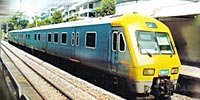
I can understand for simplicity why they designate their routes Seremban-Rawang and Sentul-Port Klang. But being so rigid about it can lead to adverse effects.
Let me just warn you that I myself am not a frequent user of the Komuter, although I have taken it many times in the past. But I hope that these silly thoughts can be explored, okay?
I assume that most people who take the Komuter are doing it to get in and out of the city (e.g. Subang Jaya-Sentral). Or users who just want to travel down the line (e.g. Seremban-Kajang).
And although there must be people who use it to cross the Valley (e.g. Seremban-Rawang), they are not in the majority. And so I think the way the service routes are designed, it seems silly why these trains have to make one full journey back and forth each branch for every run!

Why not run the Komuter to do routes like Port Klang - KL, Seremban - KL and Rawang KL or something like that. (by KL, I mean either Sentral or the old railway station).
Come to think of it, this really makes no difference. But in actual fact, delays at one part of the system can lead to other trains being delayed elsewhere, further down the line. For example, a Rawang-Seremban service might be delayed simply because somewhere in Kajang, there is a delay. In other words, I am suggesting that the operations of these services should be made somewhat a bit more independent to each other.
[If I am not mistaken, this was also an issue with the KTM Intercity in the past. I remember as a kid taking the afternoon train to Singapore. We had to wait for about 3 hours for the train from Butterworth to arrive. And that wasn't the end of the delays. As we were making our way down the Peninsula, the locomotive was faulty (that's why the train took so long to get from Butterworth to KL) and the prime mover experienced more trouble. If I am not mistaken, now the Westcoast Intercity routes start and end at KL and those from the North who wish to go down South have to change at KL.]
How do I suggest they do this? Well I hope KTM can consider introducing a variety of routes, and from studying the route map, I hope they can consider the following.
At not so busy hours, they should maintain their current service routes, as usual. But at peak hours:
- Seremban-Tasik Selatan - Passengers take the Sri Petaling LRT or KLIA Transit to continue their norhtward journeys
- Rawang-Bank Negara - Passengers take the Sri Petaling and Ampang LRT to continue their southward journeys
- Reduce service on the Sentul KTM branch - passengers can hope off at Bank Negara to continue on the Sri Petaling and Ampang LRT
- Introduce express services that bypass not-so busy stations
- Introduce services that start and terminate at busy stations like Subang Jaya, Serdang etc.
- Construct a Komuter station at Abdullah Hukum to allow westerly passengers to bypass Sentral (and finally putting Abdullah Hukum to good use)
- Continue serving the usual full Rawang-Seremban and Sentul-Port Klang routes but at low frequencies
- With the savings of "rolling stock", couple those together to serve busy routes.
Naturally the most sensible thing would be to schedule all trains, and make sure they follow their schedules. But they don't, for reasons sometimes beyond KTM's control.
So how about introducing further computerization and automation in train control? Perhaps signalling can be improved and better synchronized?
Well, all I am suggesting is for Komuter trains to try to offload as many passengers and terminate services before they enter the city. (in fact this is something like Rapid KL's new hub-and-spoke bus system)
Come to think of it, whether KTM actually changes the routes or not, passengers can actually already "improvise" on these routes themselves. But why don't they?
Firstly, synchronization and coordination. KLIA Transit trains run half-hourly. You miss it, and you waste a day.
Secondly, hopping on from one train to another (in another station!) isn't a very pleasent thing to do (especially in KL).
Thirdly, we go back to the problem of "starting fares".
Fourthly, there is the issue of different "grades of service" on "different lines". KLIA Transit, being the most posh, followed by the LRTs and Monorail and the Komuter at the bottom. And with this, we also have different fares for similar journeys!
For example, for the journey
- Bandar Tasik Selatan to KL Sentral
- Komuter - RM1.00
- KLIA Transit - RM4.20
- Sentul to Bandaraya/Bank Negara (although Sentul KTM and LRT are at different places too!)
- Komuter - RM1.00
- LRT - RM1.40
This has to be sorted out, otherwise, users have no incentive to hop on other lines, even if it is in their best interest (in getting there fast and avoiding busy stations). Harmonization of fairs better be done quick.
Yes, the KLIA Transit feels really good and the Komuter really crap. How about KLIA transit introduce a "standard class" with less frills in some carriages, while maintaining some of their current ones for "premium"?
And as for frequency, I would suggest that they cut down the frequency or totally scrap the KLIA Express and have it fully replaced by the Transit. 36 minutes. 28 minutes. Big difference.
All this can't happen until all the operators and authorities sit down together to coordinate. I would recommend a business and operations model like this to be explored, in order to allow this complicated network of operators to integrate.
As much as we would like KL Sentral to be the "transport hub" of the city, we must also recognize that due to physical and technological limitations, some sort of "disintermediation" in terms of routing through KL should be explored.
The use of buses also must not be discounted!
It is also inevitable that KTM has to
- improve on its scheduling (and having it enforced!) and also further computerization with traffic control
- increase in capacity by acquiring more rolling stock to articulate the current trains and to have more train sets in service
- improve its station quality as well as integration with other rail lines
Victory number one
The yucky Horlicks structures at Jalan Semangat?


Well, guess what:
Dear Sirs,One step at a time.
Thank you for your valuable feedback and pleased to inform that we have taken the necessary steps to clear out the debris.
We also take this opportunity to apologise for inconvenience caused.
Regards,
Azariah Tahir, Communications Manager
Office : +603-74xx xxxx
Fax : +603-42xx xxxx
e-Mail: xxx@gsk.com
GlaxoSmithKline (GSK), Lot 89, Jalan Enggang, Ampang/Ulu Kelang Industrial Estate, 54200 Selangor, MALAYSIA
www.gsk.com.my
GSK - Do more, feel better, live longer
Wednesday, September 27, 2006
KL Boleh - More thoughts
Beggars
They are not new to KL. And they can be found everywhere, not just at LRT Stations. And I'm not going to launch into a sermon, even though I am tempted to, as to why and how the people who need help the most don't seem to get it.

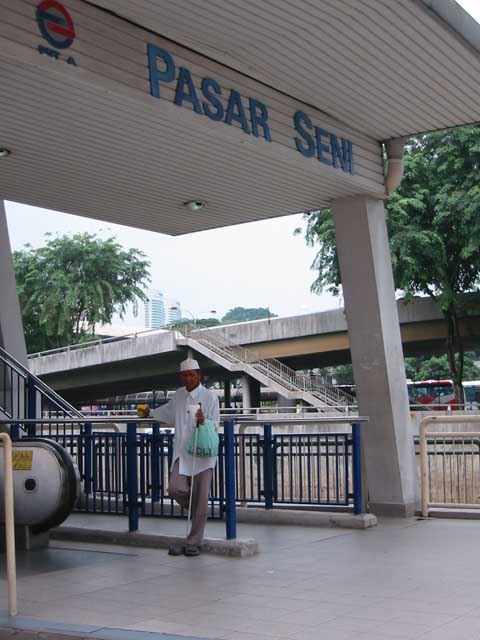
The photo above was taken at the Bukit Bintang Monorail. According to Lex, it was on the bit of the bridge linking Sungai Wang. And the ones below are at Pasar Seni LRT.

What has happened to our welfare services such that these people have to subject themselves to this lowly state? I hope something can be done to help these men and women find employment. How about the Welfare Services set up "social enterprise" to get these beggars to work stuff like shining shoes, selling tissues, selling newspapers, busking etc. at the LRT Stations? I remember growing up going to Pasar Malam and being thoroughly entertained by blind musicians. In Britain, hobos sell the magazine, The Big Issue.

(do I see a PUT-A? ekekeke)
Another irritating thing that I myself have found is the bunch of people doing "surveys" at the KLCC underpass. Knowing that they can't accost you in the LRT Station or inside KLCC itself, they all congregate in the tunnel, a no-man's-land.
As for buskers, good for them! But please, improve on your repertoire please.
Essentially, the rule I would advocate is anything that doesn't block pedestrian access.
When it rains... at the car parks
According to Lex, these photos were taken at Bangsar LRT station on Saturday. Whenever it rains puddles form at the access to the car park.

And users are expected to main lompat-lompat.

I don't know if this is the typical quality of car parks at the LRT stations. I hope not.
When it rains... in the stations
The LRT system is barely 10 years old. And it has already shown many signs of wear and tear.

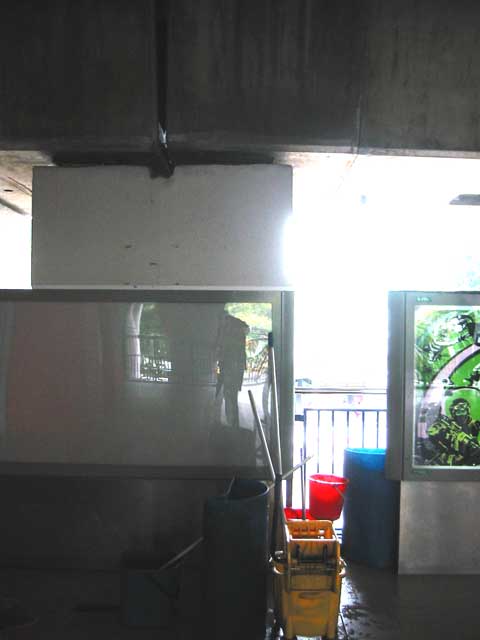
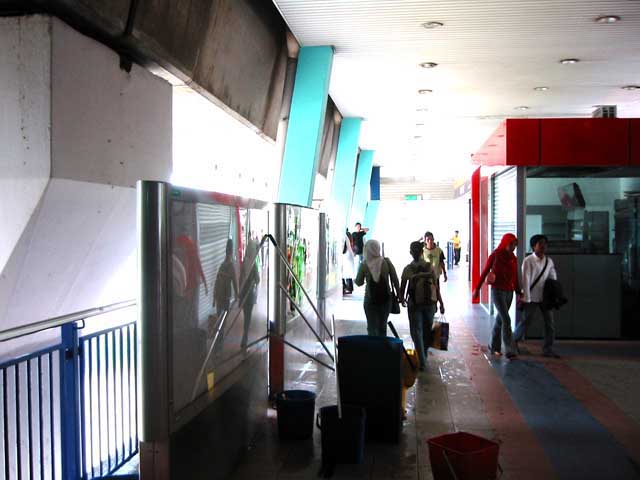
This is Pasar Seni LRT. When the rain comes down, buckets and dustbins, and janitors come out.

Ticket vending machines

Typical. Sigh.
Customer service
Over the weekend, Rapid KL launched the revamped bus services in Area 5 & 6. So many of the newbies, like Lex, needed some help with the service.
This is Medan Pasar on Monday. While some Rapid KL staff were working hard and trying to be very helpful...

Others chose to post themselves in some hidden corner (at AmBank).

ZzzzZZZZzzzz...

Meanwhile, this was another photo taken at the Pasar Seni bus stand.

Lex told me this on Monday:
When I was at KL Sentral at around 1 something, I wanted to enquire about service 115. I waited for about 20 minutes but saw no 115, and then went to ask the Rapid KL staff stationed next to the SkyBus counters... And I was then told that the bus would leave at 2. Shocked, I then pointed out to the staff the promise in the Rapid KL leaflets that City shuttles run every FIVE minutes. Then the guy pointed out RUDELY and SMUGLY, the proviso on the leaflet:
DISCLAIMER: Rapid KL reserves the right to make any changes prior to any notice.
(KLC: What horrigible English. Prior to any notice.)Case item #1
Then I told him, that yah, this seems to be the quality of service that Rapid KL wants to offer. And he challenged me to file a complaint.
I would, but I forgot to note down his name and pangkat.

The promise...

The proviso...

Well, I will try to bring this to Rapid KL's attention.
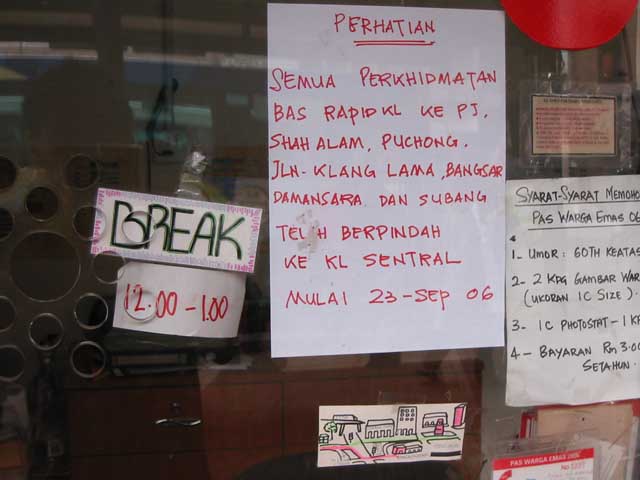
This reminds me of another instance at Pasar Seni LRT Station. An old uncle wanted to purchase a bus pass or make some enquiry at the counter (the same one as the "break" photo). There were a group of Rapid KL staff, drivers I suppose milling around at the bus shelter in front of the pondok. The uncle asked the staff if they could help him out. Then they laughed at him and pointed out the sign "solat". Need I say more?
Another incident that reader AlFresco has related to me:
I was riding the 108 from Medan Pasar to Bukit Bintang, trying out the service. Essentially this loop service takes you from Medan Pasar, through Jalan Raja Chula, Bukit Bintang, Imbi, Jalan Tun Razak and back. I was trying out the service for the first time so I wanted to see what this route looked like. After doing Bukit Bintang and Imbi, the bus driver stopped at Pasar Rakyat and asked all passengers to disembark! I was shocked. I told the driver that this was a loop service (berkeliling) and the route terminates at Medan Pasar, where it starts. He told me, that it was his break time and he was sorry, everyone had to get off and wait for another 108. I waited for another 15 minutes for the next bus. This was the first and last time I'd use the Rapid KL.Can Rapid KL kindly explain if drivers are authorized to terminate services midway and take breaks? Is this sort of behaviour rampant?
Pedestrians
Whether you use public transport, or not, everyone would agree that it really sucks big time having to walk around KL. (apart from the hot weather la)


Pedestrians have to dodge vehicles parked on the already narrow sidewalks. Crossing roads are difficult as pedestrian crossings usually don't give priority to pedestrians who have to stand in the sun. Pedestrians are forced to climb overhead bridges, even in the city centre, while subways are usually disgusting and dodgy. Drivers seldom allow pedestrians to cross roads, even at designated pedestrian crossings. Missing drain covers are aplenty.
Sigh.
Disabled friendly transport
Disabled persons have been demanding access to public transport for a very long time. They haven't been very successful, apart from that in the Putra LRT system and what used to be its Putraliner feeder buses.
The joke of the day is that today, Rapid KL in 2006, can't even get it right with this issue. Its new bus fleet is not disabled friendly, with regards to persons with mobility difficulties.
And it tickles me when on their buses, they have allocated the orange colour priority seats, but have made no provision for persons on wheelchairs. But they have chosen to label these priority seats with the "wheelchair user sign".

As you can see, the seats are not foldable.

Peter Tan has wrote about accessible public transportation.
Better signs

Rapid KL has done an amazing job with disseminating information in its short history. In many ways it has done a lot of things unimaginable under previous transport operator managements. It publishes detailed bus route information on the web, it has put up plenty of the same information at bus stops, it has printed out thousands of leaflets, it has been talking to the press. But still, there is a lot to be done, and a lot is still to be desired of. I have talked about its website and bus stop information.
I'm glad that Rapid KL has come in to save the day. Good luck!
Lessons from LA
Dear KJ John,
I like you, and probably ALL of Malaysia, am disappointed with the state of public transportation services in the country.
I write about public transportation issues in my blog, klcommuter.blogspot.com. Here I discuss the shortcomings of the current system in the Klang Valley that we have in place, and how we can improve on it.
It is interesting that you talk about privatisation in public transportation. It is an issue that I think is one of the most serious and fundamental, yet least discussed.
Rapid KL and SPNB have been doing a MUCH BETTER job than the nexus of Intrakota and Cityliner. That I think we all have given credit. Still there is a long way to go.
But there still remains the many other so called OTHER transport operators. The rail ones being KTM Komuter, ERL and KL Monorail. The buses, SJ Bus, Triton, Metrobus, Selangor, Len Seng etc.
I think that there is plenty of room for integration and cooperation while still retaining these other operators.
TRANSPORT REGULATOR
One important step would be to introduce a new public transport regulator/authority for the Klang Valley, and following that remove all other regulatory powers held by the CVLB, local councils, SPNB and Rapid KL (with their quasi-regulatory powers), transport ministry etc.
This can be modelled in the likes of Singapore's Land Transport Authority, or Transport for London. Designate routes for operators, regulate safety standards, enforce integration, bringing in common ticketing systems, building and maintaining support services like tunnels, overhead bridges, bus stops, bus stations, large important train interchanges.
Currently, there is a problem of "who does what"? And them being territorial (DBKL - we only do bus maps for Kuala Lumpur). And the massive bureaucracy.
COMMON TICKETING
Touch 'n Go is actually a pseudo-common-ticket. But there are many problems with it, such as it not being available on the ERL, and the difficulty and cost of doing reloads, and the reliability issues of card readers at turnstiles.
There is also another major problem. I term this the problem of "starting fares". Hop on a train line and your first station would cost you anything from RM0.70 to RM1.20. That is pretty okay if you travel on one line to complete one journey. But if you require travel on at least two lines, you are double charged this "starting fare". And this is potentially a major disincentive for the use of rail travel. I have discussed this at my blog:
http://klcommuter.blogspot.com
I also would like to see system-wide bus and train passes, working across all operators. But there are many complications, that I have discussed at klcommuter.blogspot.com.
PRIVATISATION
I don't think these OTHER operators need to be bought up to ensure integration - both physical and ticketing wise.
An example I always like to quote is that of London. Two different operators run the London Underground, yet most people don't really know about it. In fact they don't really care. Why? Because standards of service, livery, ticketing and other issues have been standardized. Bus routes are all issued competitively and are subject to pretty frequently put up for re-bidding.
How does London do that? Essentially, the Mayor of London, through Transport of London, contracts out the provision of these services to private companies. The 2 Underground operators and the many bus companies. The Mayor purchases these services from these separate companies in wholesale, but then redistributes, repackages and resells these services to the general public.
So ticketing, marketing, stations, quality standards, customer complaints, safety standards, and even the livery (the red buses!) - are all standardized and controlled by the Mayor.
This allows the Mayor to have close control in achieving certain social-political targets (universal service, round the clock service, discounts for senior citizens, subsidized routes), while unleashing the competitive powers of private enterprise that bid for the provision of these services.
Performance charts are published so often, showing how punctual and reliable services have been.
And how can we do this in KL?
Have the routes be put out to competitive tender and subject to bidding every so often. The lowest bidder will receive a fixed annual or periodic fee for the provision of these services subject to various perfomance indicators. Define clearly what services to be provided: i.e. how many bus runs a day, how often at what time, how big a bus, considerations for traffic congestion and roadworks. Have these performance indicators inspected and audited.
So although individual routes are run by monopolies, in effect they are not because the end customer doesn't make direct payment to this company and this route monopoly is subject to competitive bidding, so any monopoly behaviour (apart from pricing, which doesn't apply here anyway), such as offering unreliable service and compromising on safety would be subjected to fines from the regulator, or be disqualified from bidding in the next period.
At the employee level, pay-performance compensation structure for employees should be further improved, if not introduced. Bus drivers' pay should be proportionate to his performance i.e. with regards to how hard he has works, his safety awareness, his punctuality, the busy-ness of his routes etc.
This way, Metrobus, Len Seng, Triton and the likes can continue operating, subject to being able to compete for the tender, and also being able to fulfill the other requirements. (With standardized livery, hopefully in the future, we can have something like the iconic red buses in London! How about beige eh?)
The same can be applied for rail operators. Have Rapid KL pay a fixed periodic fee to KTM, ERL and KL Monorail to run their services, and in exchange Rapid KL take over all ticketing revenue and marketing while the individual operators continue with train operations and maintenance? But of course there will be differences, such as contracts have to be made much longer than in the case of buses, due to the heavy fixed cost investments and the immobility of capital across systems (unlike buses that can be quickly converted for use elsewhere much easily).
In a way, it's like the in-thing PFI that the government has been shouting about. But like everything else, it is not without its controrvesy. But it should be something to be explored, given the ability of it to allow more integration than currently available.
What a blog-whore I am.
Tuesday, September 26, 2006
KL Boleh - Sentral, the new Kotaraya
Rapid KL staff were seen everywhere around the bus stops at KL Sentral, especially at the main one at Jalan Stesen Sentral 3 i.e. where the KLIA and Genting buses stopped. They were giving out leaflets about the new routes and also the City Shuttle ones.
Well done, Rapid! (although there are some "customer service" issues which I will discuss later)
Sentral escalators
To get from Sentral proper (railway halls) from the bus terminal (at street level), there is this pathetic Imbi Plaza like narrow escalator available. And in typical Malaysian fashion, it crawls.

And in typical Malaysian fashion again, passengers coming down have to walk down a very narrow stair.
I would recommend that KL Sentral management add more escalators in this area, and make them high speed. I don't think downward escalators are a luxury, they are a necessity.
One thing I don't understand is that if shopping centres can easily install so many escalators (up and DOWN), why can't train stations? How expensive is it to purchase and operate one?
Sentral proper
Once inside the rail halls in the main building, one would be greeted by the rows of gedung-gedung pakaian. Why people would want to buy clothes in a railway station really puzzles me. But this is Malaysia, and anything goes.
Okay. If this is indeed a shopping centre, then where are all the escalators going up and DOWN? And if this is a train station, why is there a Kamdar right in the main lobby?
There is also another "fashion" outlet in the unoccupied LRT ticket hall. (in general, each railway line has two entrances in. The Komuter utilizes both, but Rapid KL being cheap is only using one). And they forgot to remove the signs. (the blue sign at the top right)
I am not anti retailing. But I think there is a time and place for it. Most of the shops I see are those stalls selling handphone reload cards. WTF. I think good retail outlets would be like the MyNews/Kiosk/7-eleven kinda outlets at the Monorail stations. Or in Singapore, they have their Citylink mall at City Hall MRT.
Outside stations, there are the "pasar malams" that have been not carefully laid out, such that now going in and out of stations is like an obstacle course. Where is the planning!?
Meanwhile the signs have yet to be updated. Putra LRT's still the in thing and wherea are the directions to the buses.
Illegal parking
There is this huge-ass car park (and a "pasar malam") in the giant space between the station and Jalan Tun Sambanthan.
Instead we have these tight arses who choose to park their cars here. Right now, they are not obstructing any traffic, yet. But I can assure you that without any enforcement, this would become standard practice.
These cars better not belong to the Rapid KL staff on duty.

PanduCermat.org.my?
Nation of shopkeepers
I've blogged about this before. The rational decision to introduce a covered walkway to link the Monorail station with Sentral, followed by the not-so to surround it by a bazaar.
It makes the corridor stuffy, crowded, dirty and difficult to navigate.

Dare they proudly hang our vertical form of Jalur Gemilang in that ugly horizontal manner? And then leaving behind this mess!
What a bunch of patriots.
The car park is quite big, and hardly very full. So I don't see why KL Sentral shouldn't install the tents also in the car park, slightly further away from the walkway. Pedestrian traffic and shoppers thus compete for space in that tiny space.
Jalan Tun Sambanthan
This is the monorail station wrongly-named "KL Sentral". And look at the signboard and you can judge the high quality of installation and maintenance. Syabas!
Where's the O-N?
As you can see on the left, the "pasar malam" is being put up. I can't wait to see what happens when it rains at peak hours and Jalan Tun Sambanthan is jam packed.
Malaysia boleh in action again.
And look at the perfect seemless integration the "pasar malam" has with the bus network! The bus stop, the bus sign pole and the "pasar malam", and accompanying tong sampah have become ONE. Rapid KL, please learn! (he he)
And with this kind of third world mentality, commuters are forced to stand on the road to wait for buses. Otherwise, they might just miss a passing bus.
Bloody bas persiaran.
Suggestions for a first world station
Reallocate space amongst bus services and companies. KLIA, LCCT and Genting buses also crowd in the same area as Rapid KL. Given they were there before Rapid moved in, they have the choicest waiting bays. This has led to City buses being at on end of the building and Area 5 & 6 buses at another. How about moving these OTHER buses up to the bus and taxi waiting area opposite Hilton and leave this area downstairs exclusively for Rapid KL (and Triton)?
Better signs. Given that this is a pretty new system at KL Sentral, I hope Rapid KL and Sentral will put up better signs to direct passengers where to go, in the very very near future.
Install permanent DBKL and traffic police officers to control traffic and enforce parking regulations.

Better access to Sentral proper - high speed escalators in both directions, stairs, clear the railway station hall, better signs.
Ban smoking in the bus station.
Fix Jalan Tun Sambanthan. I hope that Sentral, DBKL and business and community leaders can come together to bring some order to these street trading. I love the charm of street hawkers, but I think in a critical place like Jalan Tun Sambanthan and KL Sentral, it MUST be done properly. Cleanliness. No enroachment of stalls into the five foot way. Proper ventilation. No obstruction of street traffic. No taking over "bus stops". Deepavali or no Deepavali, Kongsi Raya or no Kongsi Raya, there is always the need to do the right thing, and the thing right. There is always the place and the time for everything. A bazaar in the middle of a busy pedestrian area is not right.
Quickly start work on the "shopping complex", if at all. Install a walkway at the same level as the monorail station (airconditioned with highspeed travelators!) right to the platform, to minimize walking up and down to get from both stations.Monday, September 25, 2006
KL Boleh - Keadaan jalan raya yang dahsyat
Yes, please send in your experiences and evidence to me at klcommuter@gmail.com
Okay, there are so many photos, that I don't know how to start, but I'll try to make it as systematic as possible. I shall call this particular series of photos by Lex KL Boleh.
This one's about our roads: KL Boleh - Keadaan jalan raya yang dahsyat
Bus lanes are for...

Climbing to the roof at Jalan Cheng Lock
The scourge - Metrobus

They're everywhere.

With Rapid's pull out of the city, Metrobuses have now taken over the role of number one road hogger in the Bangkok Bank, Kota Raya, Jalan Hang Kasturi, Central Market area.

Bus lanes are used as parking bays for buses and taxis. Not for picking up passengers, and not for zipping though the traffic. In fact it is impossible to travel in bus lanes. Sigh.

In that case, I think we should just scrap bus lanes.
Illegal parking
This is bad...

And these are worse:


And these the worst:

This is busy Medan Pasar at lunch hour outside HSBC. Do these friggin drivers know that they are causing a massive bottleneck in the area? Obviously no.

Where are the mata?
Intercity buses
Puduraya still operates right smack in the middle of the city centre. And what a shit hole it is.
Buses line up on Jalan Pudu all the way to the Magnum building in front of the Tungshin hospital. (no photos shown).
There are also other so called "bus terminals".
In the vicinity of Pasar Seni LRT, the Post Office and the Kuala Lumpur station at Jalan Cheng Lock:

These are the Seremban buses I think.


And these, at the Sinar Kota Lebuh Pudu area. As you can see, there is NO LAW.

Taxis

This is the Indonesian Embassy at Jalan Tun Razak. Taxis wait outside the embassy, double-parking and even triple-parking.
The sermon These photos show that no matter how much money is poured into the bus system, no matter how much politicians talk, no matter how much Binafikir can be consulted upon, our road system will remain shit if there is no LAW and no ORDER.
Bus drivers are too damned lazy to stop in the bus lay-by to pick up passengers. Cars and taxis park at bus lay-bys blocking buses. Taxi queues extend for blocks and in lanes.
Four lane roads effectively become two lanes when cars double park.
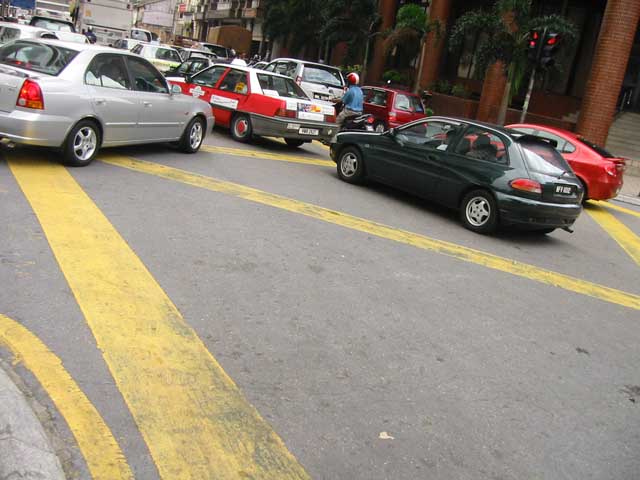
Motorists meanwhile don't understand what yellow boxes at crossroads and junctions are meant for.

Millions of ringgit can be used to upgrade Puduraya, build transport terminals at Plaza Rakyat and where-else, and yet buses pick up passengers in the middle of Jalan Cheng Lock.
So where are the enforcers of law and order? Where are the traffic police to clear the roads? Where is Dewan Bandaraya Kuala Lumpur to issue parking compounds, tow obstructing vehicles and clamping illegally parked ones? Where is the CVLB to ensure that out-of-town buses and non Rapid KL buses park where they are supposed to?
I will get Lex to upload this to PanduCermat.org.my
Thanks Lex. More to come!
Also, The Star recently wrote.
First Getaway with My Boy
This is something I stumbled upon while doing some "research".
Time to get some "perspective". And please refrain from excessively banging this girl okay:
Genesis of Mind
First Getaway with My Boy
Anyway, we reached Royal Bintang Hotel at around 2pm, after battling the traffic jam, with the uncle honking at the crazy taxis. Then we checked into our room, located at the NON-SMOKING level. We were finally smoke-free!
We blasted the air-con in our room and scooted out to jalan jalan. KL is damn warm, but Singapore is worse. Trust me.
Midvalley Megamall was our first stop. But first, we gotta figure out our way there and the hotel staff were kind enough to help. Heh heh. We're really lucky.
We walked a short distance to the KL Monorail, Bukit Bintang Station. We needed tickets to bring us to Midvalley station.
Boy: "We need to get to KL Sentral first."
Me: "Ok, we go there to change train?"
"Yeah, but I think we need to get the tickets to KL Sentral."
"HUH? Not to Midvalley?"
"No leh, the guy said go to KL Sentral first."
"Not cross the platform at the Interchange meh?"
"We not in Singapore lah dey."
Yea, we not in Singapore lah dey. We were in KL. Where transport SUCKS!!!
Big time.
5 stops for RM2.10 per ticket. Summore cannot cross the platform one, nabeh.
We alighted at KL Sentral, and we had to find our way to the KTM Komuter. We were told it was just across the road from the Monorail station, but no dude, we don't see no KTM Komuter!!!
Nevertheless, we braved the traffic and crossed the road. My boy loves the traffic light's green man. Unlike Singapore's flashing of the green man, it RAN. The legs could move, holy shit. Hahahahaha! Kawaii!
Anyway, we found our way after walking through this pasar malam and crossing not just one road but 3? Quite scary, because the cars just zoomed everywhere. So we actually crossed 3 ROADS instead of just crossing one platform, after reaching their so called "Interchange". I'm stunned.
I'm so thankful for Singapore's transport. At least I know I'm not paying the hefty adult price for crap transport.
We bought 2 tickets to Midvalley Station (1 stop only lor!) for RM1 each.
So much trouble just for ONE STOP to Midvalley Station. Nabeh. Malaysia, please implement the cross the platform thing. Makes things easier, ok?
They really need to put some brains into their transport facilities.
Firstly, we had to wait for 15 long minutes (!!!) just for ONE train to bring us to our destination which is just ONE STOP away (can't get over this).
Secondly, it was warm (no air-con, just industrial fans) and dark (lousy lightings), without much seats (I think they damn budget).
Thirdly, we had to run after the train because it overshot our waiting area. Yes, the fucking train was shorter than the platform. What the fuck?!
Grr.
Anyway, we got to Midvalley Mega Mall and I was a little grouchy already. Wasted so much time just to get there.
I know what you're thinking. But I just wanted to humour all of you today - okay?
Laugh at them, and laugh at ourselves. :)
Laugh all you want and care, but next year is Visit Malaysia.Sunday, September 24, 2006
Unsolicited advice

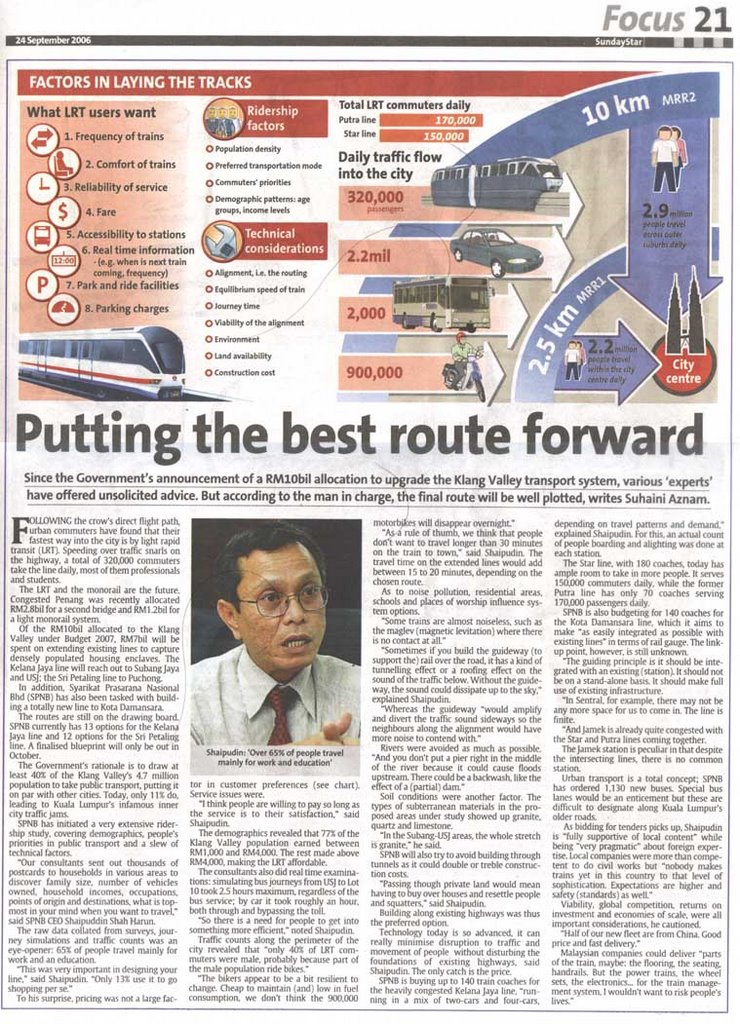
In today's Star, we had Shaipuddin Shah Harun, the CEO of SPNB (the dudes who own Rapid KL's infrastructure) shed some light about the new Damansara line and Subang and Puchong extensions. I think it is a very interesting read and it sounds as if SPNB is trying very hard to avoid the mistakes of the past. Good luck!
Read the article here.
The Star meanwhile had this really silly introduction under the headline:
Since the Government’s announcement of a RM10bil allocation to upgrade the Klang Valley transport system, various ‘experts’ have offered unsolicited advice. But according to the man in charge, the final route will be well plotted, writes Suhaini Aznam.
Well excuse me Suhaimi, but the last time we "experts' didn't offer unsolicited advice, or at least our advice wasn't heeded, we had the following:
- Abdullah Hukum LRT station, and not Mid Valley LRT station
- Masjid Jamek being such a mess
- KL Sentral being separated from the Monorail
- Putra LRT stopping short of the Federal Highway, rather than crossing into Subang Jaya
- Putra LRT running on one system, and Star LRT on another - and now we have a problem of too many trains on the wrong system
Well, I remember one advice that was listened though. Star LRT was toying with the idea of having air-conditioned coaches. As in, one of their initial plans was to have its LRT coaches not have air cond, but with open windows. Ha! Ha! Ha! Luckily a lot of noise was made... and that plan was no longer a toy.
Ok, back to SPNB and its plans. It looks like SPNB is well aware of plenty of problems from the legacy systems and they are quite keen to avoid repeating them. Shaipudin sounds as if he has done his research in understanding what ought not to be done and what cannot be done.
For example he says the following:
- it is unrealistic to expect bikers to use LRTs in the near future
- sound pollution is a problem with guideways
- rivers should be avoided as they cause floods
- soil conditions are something that has to be checked, especially at Subang which is granite
- tunnels are expensive - up to 3 times as expensive
- private land is a messy affair
- integration at stations is a major concern
- differing rail gauges jas also been thought about
- further development at Sentral and Jamek should be avoided
- SPNB is "fully supportive of local content" while being "very pragmatic" about foreign expertise
- Viability, global competition, returns on investment and economies of scale are all important considerations
- safety is another major issue
That's why I am more optimistic than ever.
Speaking of which, KL flooded again yesterday. And this reminded me of a video I saw on YouTube recently:
And some photos I saw on a Ministry of Agriculture (?) website:


I won't fully blame the LRT lines upstream for causing all this floods (the video was taken at Pasar Seni, which is downstream, past Masjid Jamek), but I'm pretty sure a lot of it can be blamed on them. Can you imagine, with that sort of water level on the Klang River trying to pass through the narrow Masjid Jamek LRT station?
Anyways, the supposedly SMART tunnel is supposed to save KL from more of this hell.
Please don't repeat this mistake, okay?
Saturday, September 23, 2006
Cetak rompak and going cashless

For the benefit of those who have just joined, I will REPEAT and perhaps further elucidate.
- It has been reported that a lot of people on KTM Komuter services don't pay fare. I suspect that many on Rapid KL also don't pay full or sufficient fare.
- On Rapid KL's system, manual tickets are not always collected and passes are not always checked. There have been too many incidences when people walk through these manual gates without any officer around.
- For buses, there are also plenty of passengers who hop in from the back without paying, when the bus is full. I say that we should give these people a piece of our mind.

Adding on to that, I would also like to point out MORE problems with this and how we should tackle the problem. I don't think these sort of things need to be pointed out by Binafikir and the likes.
[Binafikir's the boys that have been helping Rapid KL and SPNB sort out their business and technical problems. I think they have been doing quite a good job so far :) I hope they can continue to bring these two clients to create a damn-cun system while bringing them to profitability. Remember, for the system to be sustainable, it has to be profitable. Profits mean reinvestment which is good for us.]
The issues:
- It is silly to issue manual tickets given we have so many ticket machines. But in typical Malaysian fashion - they are either rosak or only accept coins. (and the RM1 coin is no more).
- With holes in the system (the missing ticket checker), I won't be surprised if one day all the stock of magnetic tickets reaches zero. Dahsyat.
- It won't take an idiot to produce counterfeit copies of passes (and tickets) like those above. Tickets and passes like these are becoming the norm.
- Even worse, I won't be surprised to see copies and booklets of these passes being sold in Chow Kit or Petaling Street. If they can do holograms and LV, this ought to be easy-peasy.
- Pass fraud is easily done. Scavangers and junkies would be seen hanging around bus stops searching for used passes that are still valid for the day. Passes can be resold.
- Passes can be given away to friends without much difficulty, probably at the end of the day. TnG can also be lent out to mummy, but you're not going to give away your TnG to your colleague.
- Station staff are needed at platforms and bus stops more than anywhere else. They shouldn't be wasting time issuing tickets over and over again, everyday.
- Issuing manual tickets and passes involve lot's of risk and costs associated with handling cash. Why not allow users to top-up TnG's with cash and passes at ATM and ticketing machines?
- Why let bus drivers waste time in the morning issuing daily passes to passengers when their job should be filling up the buses quickly and following a schedule?
- Why risk letting buses collect cash? By the end of the day, buses turn into coin boxes on wheels.
- The opportunity to collect valuable passenger travel information has been lost. With cards like TnG, journey information can be collected from the very first bus journey you make. This valuable information can be used for Rapid KL to plan better, more direct routes. No? (regarding privacy issues, the cards can also be issued anonymously).

I propose that Rapid KL immediately cease to issue any manual tickets and passes, as well as magnetic tickets as soon as all the Touch 'n Go infrastructure is up and running and proven to work OKAY in all LRT stations and buses.

Everyone ought to have a MyKad by now, so everyone ought to have a TnG card. Those who wish to give up anonymity should purchase a TnG and not register the card, or register it using a fake name (although you thus give up certain rights).
All the passes that are currently being issued should be available in TnG form, and I strongly urge RapidKL and other operators to adopt capping and solve the problem of starting fares.
Cards should be sold at ALL LRT stations, bus terminals, banks, post offices and hopefully at mama shops and 7-Elevens. If any Tom, Dick and Harry can sell mobile phone prepaids, I don't see why cards can't be easily sold and distributed.
All ATM machines at all LRT stations should allow topping up of TnGs and also enabling users to perform other functions, such as purchasing monthly passes into the card. Abolish the 50 sen charge on TnG top ups at ATMs.
In fact, make all ATM machines at ALL places TnG-able.
Install new general ticketing machines (ala Singapore MRT) at LRT stations that accept cash, credit card and ATM cards to also do similar functions as ATMs.
Sell TnGs at airports and other bus and train stations. For example, at KLIA, sell the KLIA Express tickets to KL first-timers in the form of a TnG card. If these people are enterprising enough, throw in discounts for places like KL Tower, Aquaria and the likes. And these tourist passes would be treated like souvenirs, no?
Can you imagine the possibility of not having to touch those yucky one ringgit notes? Or having to dig for loose change? The most realistic way to start this cashless revolution is to start encouraging the use of TnG in public transportation applications.
Sooner or later, it's use can be extended to paying parking (without the bloody 10% charge, and perhaps ala Smart Tag? wow!), payphones, buying newspapers and magazines, vending machines, parking meters, use at Mamaks and coffee shops and McDonald's and RotiBoy.
We have so many wallets that are ready to use this applications, but they are not being encouraged. Please, TnG and Rapid KL, shouldn't you do more to encourage its use?
For transport operators, it's going to mitigate the potential for fare dodging. For us people on the street, it's less yucky money. For TnG, banks and merchants, it's better business for you and cost savings. For Rapid KL and authorities, it's amazing wealth of journey data.
It's ironic for me to advocate this idea when one of the main icons behind our ten ringgit note is a Putra LRT.
(I also hope that Shagadelica's experience has been fixed eversince.)
Rapidly detereorating website
It is so bad, ugly and kerajaan-Malaysia like that I can't believe it is 2006.
It is so bad, it looks as if they cut-and-pasted everything from a MS Word document into Dreamweaver.
It is so ugly that it has reminded me of the existence of Geocities and Tripod.
In fact, the word is, excuse me, fugly.
It is so content-less, that in this two weeks of me writing this blog, I have written more than has ever been published on Rapid KL's website.
Oh, by the way, the website:

Ok Rapid KL, listen:
Language options
You have failed to recognize that the biggest group of loyal customers don't do English very well. It would be very helpful if you published everything in Bahasa AND English, AT LEAST.
Even then, most of your pages are written in English, but we see sprinklings of Bahasa, especially at your bus route information. It is so obvious that I know it's a cut and paste job.
Outdated
Even the information on your front page is outdated (at least there is no cheesy, noisy, takes-forever-to-load and annoying Flash, ala I want my website to look like Zouk's).
You have revamped your routes and so your feeder bus information is all outdated already. Your places of interest - ha ha ha.
Difficult to understand
The fare schedule is too tiny for most. Even then, the design isn't standardized.
Integration with other modes
I know that the monorail, Komuter, ERL and other buses are not your business. But given that Rapid KL is the biggest, and is quasi-authority like in nature, shouldn't Rapid KL be the one who tries to involve and co-opt others?
Why can't you publish fares for others? Station opening times for others? The bus routes of others?
If Rapid KL refuses to step up to this challenge, who will do that? Some might suggest DBKL. But knowing DBKL, they're "jurisdiction" is just Wilayah Persekutuan Kuala Lumpur. Just take a look at this ITIS thing.
Inconsistent layout and content
Just try browsing through bus routes. To do that, click Network on the navigation bar.
And a whole list of thingamajigs appears. Kelana Jaya Line, Ampang & Sri Petaling Line, Train & Bus Service, Selayang, Kepong & Gombak Bus network, Wangsa Maju ada, roti planta ada, thosai ada, nasi goreng ayam, pattaya, cina, USA pun ada. Bos mau apa?
Wtf.
Can't they list it down as Train and Bus services? And then put draw a map showing the 5 zones for buses?
And then try reading the bus network info by clicking on one of the KL City Shuttle. Selayang, Wangsa, Cheras, Damansara points. A map appears. And then what? Click on the map, and a detailed PDF would appear. Or a detailed list of bus routes.
Wtf man.
And then for those without detailed map (which is most of them), the tiny map is pretty much useless as it is almost impossible to read the detail.
The only area map which is nice enough to look at is the Area 1 i.e. KL City Shuttle Map. That was the first Area revamped by Rapid KL. I guess like all things, they lost steam when it was time to do Area 2. Sigh.
(btw, where is the Area 4 bus route details?)
Overall design
It's ugly. And sometimes it is difficult to spot links. It is quite obvious that a lot of the content was done through copy and paste means, which may not be appropriate all the time.
Even Wikipedia
Has better, more organized information than Rapid KL. Check out the Rapid KL entry.
Solutions
- Totally redesign the website. It feels so 1997. It is quite a depressing sight.
- Produce system-wide information - including those from other bus and rail operators.
- Include a journey planner.
- Put up plenty of maps. People would like to know exactly where to catch buses. Put them in GIF for easy web viewing (like Area 1) and PDF for printing (like Area 5/6).
- Explanation on how to use buses. Especially so with this local-trunk-city business. This information is already on the site, except that it's all encrypted in the many press releases.
- Service information. State the quality of services at the moment. So for the LRT lines, identify which parts are busy at the moment and also if there are delays or breakdowns. Let people plan before they leave their homes and offices. Think ITIS.
- Putting up more station information would be great. List down which stations have how many car park spaces at what price.
- For bus route information, I hope they can organize the thing to further highten our viewing experience (tee hee hee). Detailing it in road names is good, but I hope they can also include landmark information.
- Guides on how to use the rail systems. Masjid Jamek and KL Sentral can be quite confusing. Put this up for the sake of tourists and first timers.
- Show how to get connections to outside the Klang Valley. Information on Puduraya, Plaza Rakyat, Jalan Duta, Putra and the likes.
- Show local maps for LRT stations. For example, where can I walk around PWTC? Or where to catch connecting buses at stations - where do I catch the MidValley free shuttle at Bangsar? Or, how far am I expected to walk from Bukit Nenas to Dang Wangi?
- Include information from the Komuter, Monorail and ERL, and also other city buses. Please don't be selfish and territorial about it. Rapid's charter states that it is to provide an integrated public transport system in the Klang Valley. If they can't provide the services themselves, they should co-opt others.
- Safety information. What happens if another 24/7/06 happens? How about what do we do when we see an unattended luggage item?
- What are your KPIs? Your short term and long term goals? Make it explicit, and we can help you reach it. Right now, a lot of riders don't understand the relationship and power held by this network of agencies. What is DBKL's role? Rapid KL's? Prasarana's? Transport Ministry? Commercial Vehicles Licensing Board? Let us know what Rapid KL can and cannot do and then maybe we won't taruk you so much.
- Have a proper customer support service. Haven't tested out the 1-800 yet, but I have sent an email to suggest@rapidkl.com.my - no reply. But then, isn't it TYPICAL for MALAYSIAN firms to not reply?
Friday, September 22, 2006
Aesthetics
To us, sights like these are pretty common:

Pondoks

Plastic structures

What's there to smile about?

Typical tiang with accompanying A4 solutions

Typical A4 solution

Accompanying ugly website with scrolling text
Whereas elsewhere, there are other places which are light years ahead (although buses and trains in a lot of places can be pretty pretty dodgy and manky).
Let's explore how transport authorities around the world are working hard to ensure that public transport is not associated with UGLY.
Beautiful Subways
Below are photos of subway and metro stations from around the world.

Pictured above is the Tehran Metro. Wow. Tehran!?

Above is Minsk. I bet you don't even know where it is.

Above is Southwark, in London. It's pronounced suth erk, btw.

Parque station, Lisbon, Portugal.
And above is Singapore, our neighbour which manages to piss of our short-sighted leaders and yet inspires the rest of us.
These photos are from Beautiful subways from around the world. No need to go to Page One at Kino KLCC to buy a 300 ringgit coffee table book.
Beautiful identity
Transport literature is also something I hold important. When I travel the world, I try to collect subway maps.
And after seeing so many subway and transport system, I still feel London's the most beautiful. (I love London, I am biased).
Look at this Tube map showing parts of London's West End.

And the really elegant looking corporate logo for the Underground - the roundel:
Meanwhile, what's Rapid KL's?

A monotone rainbow.
Back to maps. Our official Rapid KL one is as follows:
Quite good actually.
But let's see how this extends to other Rapid KL literature:

Hmmm... Well, how about London?
Below is a bus map. Here is the PDF of it.

And do you remember the spider maps?

We have hope
Interestingly, the good people at Vector Designs have produced an amazing and beautiful public transport map for Kuala Lumpur City Hall.

With all this redrawing of Rapid KL's bus networks, this bus map's pretty much outdated (2005). But a new one ought to be on its way. The map's tastefully done and it's so intuitive. I hope this map would become widely adopted and would be extended to the rest of the Klang Valley and Malaysia.
Sigh
Well I would give Rapid KL a benefit of the doubt. They are barely a couple years old, and trying to make things beautiful ought to be one of the last things on their mind.
But in the long run, something has to be done to come up with a tasteful, nice and consistent corporate image for all of Klang Valley's public transport (not just Rapid KL).
I'm not going to deliver a case for aesthetics. It's subjective, it can be expensive and there are no clear benefits.
(WARNING: excessive goreng-menggoreng and warped reasoning ahead)
But wouldn't it be nice to treat all this public infrastructure as not just mere functional objects? I think if we can mould an identity and image for these uber-plebian instruments, public transportation can be transformed into an institution that everyone in Klang Valley would love. And once it becomes a loved institution, riding on the LRT won't be such a torture anymore.
Disabled persons and public transportation
Can disabled persons use the RapidKL network of buses? Come witness for yourselves what 30 disabled persons have to face trying to board the buses.
New Bus Network Service - accessible to disabled persons??
Accessibility of RapidKL Buses for Disabled Persons
Venue: Bangsar LRT Bus Station
Date: 24 September 2006
Time: 11.00 am
Peter has also written about accessibility issues for disabled people.
Pandu Cermat Jiwa Selamat
In my humble opinion, it is one of the better government campaigns. I think deaths on the road is a scarier thought than dying because of tobacco.
Ok. Let me just re-clarify my position. I also drive, and I enjoy driving. Given a pretty good amount of money has been spent on roads, we have pretty ok ones. But what I am quite sore about is the belief that building more roads helps alleviate traffic congestion.
I am not anti-car. I am just pro-choice. I would like to have a variety of means of travelling around. Sometimes I like to drive around in my diesel guzzling SUV. At other times I like to scoot around on my motorbike (not!).
At other times, I wish that I could travel to work without having to worrying about the damn Kancil that cut me or the Waja that didn't let me pass in spite of me signalling.
Unfortunately, for most people, worrying about that Kancil and Waja isn't as bad as worrying about arriving to work late because a bus didn't show up. Or worrying about getting my feet wet as I cross Jalan Tun Perak.
Oh, back to the point - Pandu Cermat.
They have produced some really silly ads. Like that little boy crossing the road, and then screaming like a girl. For us supposedly sophisticated folks, we might laugh about it. But to some other people, the only way that they learn of things is by watching the television. (oh and I love the Rudy and JJ rempit drive safely spoof, tee hee hee.)

For most of people, I think the Safety information and tips part should be a very useful reminder.
Other than that, the site's pretty boring. I think you can play with some silly games.
The part that I think deserves the most amount of publicity is its Hall of Shame / Hall of Merit.
I'm not sure if JPJ and the police would do anything about the offenders, but it sure is quite fun uploading photos. It's quite bad actually, where the culture of snitching and reporting on others is being encouraged. Bah. But drivers like that deserve it.
Just a reminder, if you yourself are in the driver's seat, don't you think it is unsafe for you to take control of a camera?
Anyway, for pedestrians and public transport users especially, we encounter many obstacles in our travels. Take loads of photos of taxis blocking bus stops, buses doing silly things (think Metrobus), cars parked at pedestrian crossings and pavements and the likes.
Let's keep our roads safe. Happy travelling.
Myths about our public transport
The only time I use the LRT is to go to KLCC.These are things I hear from my friends about public transport.
The KTM Komuter at Mid Valley is to bring in all the Ah Bengs from Kajang and Seremban.
Public transport to Bukit Bintang? Monorail you mean?
The only public transport to KLIA is through KLIA Express.
Take a bus? For what? Join the poor smelly people and then get raped later.
What? You walk from your house to the LRT station? Siau.
I don't blame the majority of us supposedly middle class, educated, white collared, English speaking people for harbouring thoughts such as that.
For way too long, public transportation in Kuala Lumpur, especially buses, has been left to rot and disintegrate, resulting in it having a ridership consisting of mostly people who can't afford any other means of travel.
As a result of this, this whole mode has been stigmatized and stereotyped. It is seen to be un-cool riding a bus. It has become necessary for mom, dad, bro and sis to pick you up at the LRT station. It has become "dangerous" to walk back home, or silly to take part in the never-ending-wait-for-the-bus game.
I don't blame us middle class, suburb loving people.
Too little money has been invested, too little sense has been involved in planning, too many broken promises have been made and too much has been wasted.
One of the main reasons for setting up this blog was to continue to irritate and bug policymakers and transport operators to buck up.
The other was to louden the voice of consumerism amongst the rest of us.
No matter how wrong, or right, these myths of public transport are, they are bound to be proven true if we continue to stick with our old ways.
If we refuse to step into buses, and claim our right to use these services, the planners will have an excuse not to listen to us. And they will allow the system to fail, again. Why should they bring in more routes into the PJ-Damansara area if it's only going to serve the Kayu Ara folk?
For poor people, if the buses are shitty, they just sulk. For us, supposedly more affluent ones, on the other hand, with shitty buses, we drive, and listen to MixFM. And so we let buses and public transport become an increasingly lower class facility. And then we relinquish our right to demand a better bus service, as we are no longer fare paying consumers.
And we know that poor people are really bad at consumerism! And thus, we also then delegate the responsibility of improving our city lifestyles to a poorer and less educated social constituency.
Brits complain a hell lot about their supposedly unrealiable public transport system when in fact it is much better than Malaysia's! These "unappriciative" rich Brits (which include lawyers, bankers, consultants and civil servants) who always complain about the horrible aging London Underground and National Rail use these systems everyday claim their right to the system and thus have a credible claim in making things better (read: complaining).
So I urge you, discard those myths and prove them wrong. Give public transport a try, and continue whining about it.

If it's good enough for Ken, then it's good enough for me
I hope they got the message

This was published in The Star today. Quite a bit of it got chopped off.
It also appeared at blog.thestar.com.my.
It also appeared in Malaysiakini.
Also at The Cicak.
It was originally published here.
Remember - today is World Car Free Day!
Some people are more equal than others


Public transportation means...
Why do you think they are so "passionate" about keeping Malaysia Airlines alive? Because their first-class holidays in London, New York, Hong Kong and Perth are at stake. Tsk tsk tsk.
They don't give no jack-shit about how the other millions of Malaysians travel to work, school and play everyday? At least, they don't show that they do.
Say what?

Where are the details of these rolling stock increases? There has been much talk about it for quite some time already. You mean there are plans to buy more rolling stock, or the rolling stock has already been bought and is on its way, or they have been hiding some rolling stock?
I am disappointed because it appears as if this Deputy Transport Minister doesn't know what he's talking about, or at least that's how he makes himself out to be, or maybe that's how dumb The Star has made himself out to be.
Another article by The Star recently has meanwhile shown KTM's side of the story, and if I am to also believe this, I don't think it is just a simple matter of buy more, increase capacity. This deputy minister talks as if the government is Santa Claus, ready to dish out prezzies to those who behave.
Better service after overhaulI would rather believe En. Roslan from KTM, with his more honest assessment on the state of the KTM Komuter services than a Tengku Azlan (who has probably never rode on one) who can promise upgrades and capacity increases.
KERETAPI Tanah Melayu (KTM) Bhd finds it hard to cope with the sudden increase in its commuter service passengers and it is appealing to commuters to be patient.
Its commuter services general manager Roslan Mohammed said the frequency was expected to improve once overhauling works on all its 35 trains have been completed by next year.
“Looking at the current capacity and our service during the peak period, we just cannot cope because there is a jump in the number of commuters using the services. Currently, we are carrying about 100,000 commuters a day compared to 70,000 last year,” he said during a recent interview.
“There are complaints over punctuality and reliability, and this is because most of the trains are due for overhaul. We couldn’t do these due to financial constraints, but now the Government has approved the (RM100mil) budget for all our trains to be overhauled.”
He added that the Government was negotiating with contractors and hopefully the work could be done at the end of this year and that more trains would be ready to serve its customers more frequently next year.
He said although KTM had a total of 35 Komuter trains, only 33 were in working condition.
“By right, according to our plan during the peak hour this year, we should be running at an interval of 10 minutes. But at the moment, we are running at the interval of 15 minutes. We cannot do that because some of the trains are not available,” he said, adding that most of the trains were about nine years old.
He said KTM was adding facilities at the stations, where roofs would be built to provide shelter to commuters during rainy days and there would be more car park facilities.
On the solution to the problem of all Komuter and intercity trains sharing the same railway track, Roslan said in fact no trains would be running except for the Komuter service but the Komuter service would sometimes be delayed because of the long haul of intercity service.
“We will ensure that the intercity trains arrive before the peak period. That’s the only thing we can do; we cannot stop them running the train because that is our business,” he said.
On flood problems, he said the Drainage and Irrigation Department was upgrading the drainage system near the flood-prone Serdang station while the upgrading works on the Batu Tiga station still proved to be unsuccessful.
“As for the Subang Jaya station, we are doing something under the Ninth Malaysia Plan,'' he added.
Asked about frequent stoppages, he said most of the stoppages happened at the Simpang Batu and Port Klang junctions when all trains from the Seremban, Port Klang and Rawang directions enter the Kuala Lumpur area.
“The Port Klang and Simpang Batu junctions are the busiest intersections and the trains need to be stopped for quite sometime. If the train stops for half an hour to an hour, that is when there are some problems like vandalism, theft and maintenance problems.
“If the cable is stolen, the signal will not function so we have to do it manually from our control centre, directing the driver who will stop the train and receive our instructions,” he said.
According to him, KTM lost a lot of money on theft and vandalism of its equipment along the tracks and these have resulted in train delays as well.
The Komuter trains - Class 81 from Austria, Class 82 from South Africa and Class 83 from Korea - are capable of running at the maximum speed of 120km per hour.
There are 242 Komuter services a day covered by 35 trains in the Klang Valley compared with only 10 services a day for the intercity services. ling stock has already been bought and is on its way, or there has always been extra rolling stock not in use?
But if really, dear Tengku, you mean purchasing new rolling stock, kindly share this information with us. Thanks.
Thursday, September 21, 2006
Report Card - Masjid Jamek LRT - interchange
Traditionally, this was the perfect example of Malaysian Privatisation (piratisation I mean) which went wrong.
Two LRT stations meet at the banks of the Klang and Gombak rivers near Jalan Tun Perak. They are built quite close together, although not quite close enough!
Also, the elevated LRT station for the Sri Petaling / Ampang lines is a major cause of flash floods in KL of recent years. The station surrounds the Tun Perak bridge and its supporting structures have narrowed the embankment below. Nice.
But this widescale incompetence was further examplified when KL Monorail came into the picture. I have talked a little about it, and maybe I will talk more about it in the future!
Back to Masjid Jamek.
Silly signs
When you enter the Masjid Jamek LRT station to the Ampang and Sri Petaling lines, you are greeted by these silly signs. I thought that this station was called Masjid Jamek?

Maybe they meant TO Sri Petaling and Ampang, but they forgot. Still, do you know how confusing it will be for first-timers to KL?
Interchange There are two entrances and exits into each LRT stations, as there are two sides of the busy road (doh). I took loads of photos of the side of the station on the Puduraya bound side of Tun Perak. The other side (Raja Laut bound) is slightly better though.
To get from each station to the other, you have to walk down a set of stairs, then along a pavement, and then into the other station. In the picture below, the station on the right is that of the Kelana Jaya line.

There is this tiny covered cheap looking plastic roof that "connects" these two stations. In the picture below, the station on the left is that of the Ampang and Sri Petaling lines.

Now, when it rains, how are people supposed to squeeze through that tiny bumbung atap? The roof is too small for people to pass through. Even my school had better corridors. And can you imagine how slippery the steps will be in the rain?
Also at peak hours, an obstacle course appears:


I love markets and stalls. I love keropok lekor (and DVDs). But I don't like them in my way, when I am trying to rush back home. How about Bandaraya and Rapid KL giving these stalls a better place to sell their wares?
On the same side of the road, at the other way into the station, you see this.
We can see Bandaraya spending millions constructing that ugly looking cheap ass plastic roof near Masjid India, and yet, they can't spend a little bit more to help connect the stations. Sigh.


Crossing Tun Perak
Jalan Tun Perak is a busy road. Thank God the early planners built a tunnel to link both sides of the road, allowing access to the underground Kelana Jaya line station from either side of the road.
But the tunnel is long, and if you are already at street level, it is a long escalator ride down and up again, on our extra slow escalators. So the signalled pedestrian crossing is also a God-send, although it should be our RIGHT.
Traffic on Jalan Tun Perak is busy, and most of the time, it is bumper to bumper. So I find it even sillier why they have to signal the crossing? Why not just turn it into a pedestrian crossing, with blinking amber-lights, so that pedestrians can always cross?

Our drivers need to be trained to give pedestrians the right of way, especially in urban centres, where it would really not cost these drivers anything to let pedestrians pass, when after all traffic is bumper to bumper!
And another crazy thing that goes on here is cars parked and waiting illegally by the road.
Not only do they park on the zebra stripes these cars actually block up traffic along Jalan Tun Perak. In fact, I once saw a bank organize some promotion with them having some mini-golf competition along the road. WTF. I should have just called the cops.

Long Term Solutions
Ultimately, I'd propose that better links between those two stations would involve separating passenger traffice between those entering/leaving the station and those who want to switch lines. This would involve building more tunnels, elevators, escalators and walkways. And that's too much to ask for, given the mess in this area. So how about something more realistic then?
This is the view down from near the top of the Ampang / Sri Petaling Line station. At the far back, that kampung looking building was what used to be Bank Bumiputera.
In the middle, that's the Kelana Jaya Line subway entrance.
The huge beige roof in front is the entrance and ticket offices of the Ampang / Sri Petaling lines.
A gap of a couple of meters separate these two stations.

From inside the stations, this is how close they are.


Why not directly bridge these two stations together? Roof up the gaps between the stations, while at the same time improving pedestrian access in the area?
They can tear down the metal rails and the billboards, construct the bridge, build a (permanent, not plastic) roof, and install more ticket barriers on the bridge.
And start considering solving the problem of "starting fares".
How to ride a bus during peak hours

If you notice that the bus is too full for your comfort, give up and wait for the next one.

If the front and middle is full, hand your money or flash your passes to the driver from outside. Enter from the back.

No fare dodging. Please be honest.
Corporate Social Responsibility
KPMG
CIMB
Shell
Hewlett Packard
SCOMI
HSBC
Avenue Securities
HELP University College
Sunrise
The United Nations
The Federal Government of Malaysia
Securities Commission
What do all these names have in common?
These companies and organizations are among the most notable names, and probably the biggesst employers in the Bukit Damansara - Bukit Kiara area, in Kuala Lumpur.
For some historical reasons, Damansara Heights has turned out to be the preferred commercial address for companies that want to be in Kuala Lumpur, yet avoid the downtown area.
Yet, this area is badly served by public transportation. The nearest rail links are those at KL Sentral and Bangsar. Looking at the new Rapid KL routes, only three bus routes serve this area: 617, 634 and T82. There is an odd Triton bus also servicing this area.
Can you imagine the number of workers who have to travel to this part of KL to work every day? At the end of the day, trying to get on a bus here is only the beginning of their nightmare. Buses will be packed and I really understand how these people feel in that packed bus when that bus climbs Jalan Maarof inch by inch.
They then have to join the already packed rail connections at Bangsar and Sentral.
This tacit social contract between the company and its stakeholders requires the company to preserve the environment and to make the community a better place to live in by reducing its operational footprints through socially responsible practices... If integrated into its business strategy, CSR can become a potent toll for the company to realise enhanced reputation and brand value, increased operational efficiency, improved sales and customer loyalty as well as the ability to attract and retain quality workforce.This was quoted from the recent supplement from The Edge, entitled "Corporate Social Responsibility: Doing Business with a Conscience".
Zarinah Anwar
Chairperson, Securities Commission
The practice of being a responsible corporate citizen has long ben an integral part of the bank's operations and mission to be the world's leading financial institution.
Zarir J. Cama
Deputy Chairman and CEO, HSBC Bank Malaysia Bhd.
So I find it strange that with of all this talk of CSR, these companies only like to talk about education, "nation building", the environment and philanthropy.
Here they are, these MNCs and huge-ass government departments, occupying prime property, yet they have done little to improve local transportation services.
Here is why I feel that CSR of these companies should consider public transportation:
- Many of their employees, especially clerical and support staff, travel by bus to work. Don't you think that giving them the chance to travel to work and back home in a stress-free environment is good for productivity? And how about them being able to arrive at work on time, or leaving later because they know there will be a reliable service all day?
- Many of their employees who drive would rather not drive to work, given a better condition of public transport. Driving can be stressful. Same reasons as above. I would rather be reading than think and worry about how to cut lanes to reach the exit at Jalan Semantan.
- Many customers would rather not drive to Damansara. Parking is hell. Have you seen those mega car parks outside HELP and Millenium Tower? The Immigration Services' only KL counter is that in Pusat Bandar Damansara. HELP has thousands of students. People need to fix their HP printers.
- Local transport. Suppose you work at CIMB. You think about what you want to have for lunch. And then you realize, there really isn't much choice if I don't drive. We have this "tri-lemma". The Jalan Semantan area has many-many offices, but there is nothing much to eat. Pusat Bandar Damansara has many-many offices, a lot to eat, but getting there is hell. Hartamas and Mont Kiara have no so many offices and a lot to eat. And many workers would rather not drive out to eat at lunch, because this means fighting for lunch time parking and perhaps giving up your precious parking space at the office?
How about all of these fellas, sit down together to discuss bus routes with Rapid KL and Bandaraya? How about building bus shelters with some of your profits? How about pouring money so that new routes can also serve this area? HELP, why don't you get these other companies to cross subsidize your local shuttle service and share it with the public?
Now, I suggest and hope that all companies, everywhere will re-think their company policies. Where should they build their offices? How should they help employees get to work? How can customers come easily? These questions are targeted at all, no just the companies of this area (and especially those named above).
I think that supporting public transport not only shows a good heart, it also brings in good business.
Tak Bersemangat
I hopped on an LRT to Asia Jaya as I wanted to check out the Times Bookshop sale in Section 13 (Colgate-Palmolive), near Section 14 (Jaya Supermarket).
I waited for half an hour for 904A bus to take me to Jalan Semangat. In the meantime I prepared the mini report card of the condition of the bus stop.
Jalan Semangat ain't that far, but I have a pass, so shouldn't I utilise it as much?
After waiting for that, I gave up and started walking.
And this is the first thing I saw. Thumbs up to Petaling Jaya, bandaraya bestari.


I pass a park, and I see this:
A broken fire hydrant.


A disintegrating polistyrene Horlicks "structure". It looked like shit! GlaxoSmithKline - action please!


Then along Jalan Semangat, I encountered this. I am sending this to PanduCermat.org.my.
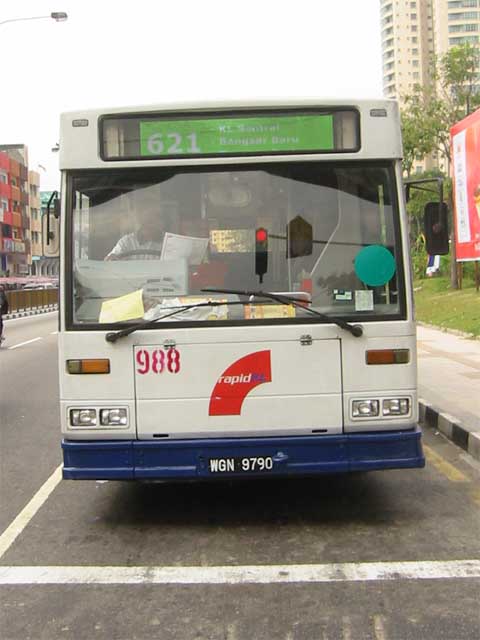
And then I saw this bus stop, also along Jalan Semangat. And the kekurangan kecerdikan of Rapid KL and planners became apparent. Rapid KL is revamping bus routes in Areas 5 and 6. Very good! Long overdue.
And they have been placing bus route information at bus stops. This is unprecendented. And I give them credit for trying. But really, it is not hard enough. This is at the bus stop near Jaya Supermarket along Jalan Semangat. Can you tell me how to read this?

Compared with London's spider maps, this is so 1901. This is one of the typical A4 photocopy (although in colour!) Malaysian phenomenon. Not even a hint of "you are now here". Or which direction the bus at this stop heads! People who are familiar enough with the route won't need to read it, but the people who need it most won't know how to!
Ok, then I turn into Jalan 13/4 at Colgate-Palmolive. And see all this:
Another broken fire hydrant. I hope the Bomba will come to fix it soon.

Missing drain covers. Need I explain?

A badly paved road.

Sigh.
Misnomer

This is KL Sentral. To the southwest of the Google Earth grab, is the so called KL Monorail KL Sentral station.
I think this is a misnomer. 140 metres, a giant carpark, a bazaar and Jalan Tun Sambanthan separate these two stations.

Currently, these two buildings, although disconnected, are recognized to form what we call KL Sentral.
I propose that the KL Monorail station be renamed something else. Maybe Brickfields?

This sort of integration, ala Malaysia Boleh, is misleading. At least other interchanges like the Bank Negara - Bandaraya and the Dang Wangi - Bukit Nenas ones are abit more honest.
To the powers that be, please update your maps and signages!
Wednesday, September 20, 2006
Report Card - Asia Jaya LRT - bus stop

This is Asia Jaya LRT station.
Actually, it is Asia Jaya LRT's bus stop. This is a pondok from the old Putraline days that has been left to disintegrate in the compound of the station. I think it is abandoned. Could someone at Rapid KL please do something about this?
This is Asia Jaya LRT station. It's a very typical LRT station. And like every typical LRT station it has a huge share of problems.

The cars you see in these photos are parked where they aren's supposed to. I won't suggest that it's illegal because I'm not sure if there are any laws that govern parking in LRT stations? With these maha-kroni companies, there is no LAW.
As you can see, these vehicles are parked in Taxi stands. Nothing wrong with it actually, because I don't really see any taxis around.

The problem is that Rapid KL has let the owners and drivers of these vehicles to park in the compound of so many LRT stations, without charging them anything. If we want to discuss Rapid KL losing money, here's an example of lost revenue.
Putting parking lots in LRT stations itself is a good thing. Provided they are properly designated and revenue is collected. In fact, I think MOST LRT stations need to have their compounds reconfigured.

With Rapid KL trying to create transport hubs and bus terminals at LRT stations, they need to seriously rethink how they allocate space for buses, taxis, car parks, waiting bays, pick-up points and disabled parking.
And look, even stray dogs have been inhabiting Asia Jaya LRT.
Leadership by Example
For example, politicians always urge the people to take public transport. Maybe more of us would, but it is an experience most of us would choose to avoid.
Perhaps our leaders ought to set aside one day to step into our shoes and try for themselves what it takes to travel to work by bus and train. They will see how packed the services are and how little has been invested over the years. They will observe for themselves the effects of bad and uncoordinated planning.
No, I'm not calling for a PR exercise. No need for their aides and the press to attend. I'm just asking that the people who make choices for us to understand what we go through.
If public transport isn't good enough for the politicians, why should it be good enough for the rest of us?
I urge all our leaders to attempt this. After all, this Friday is World Car Free day.
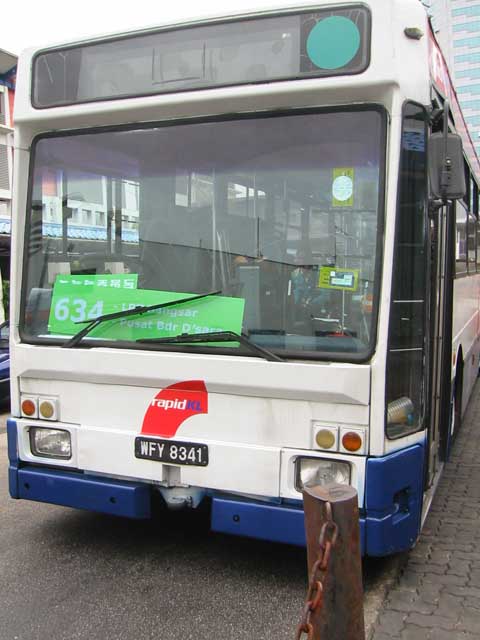
Tuesday, September 19, 2006
Fair fares
Most obviously commuters are penalized when they have to walk up and down numerous flights of stairs and escalators (and cross main roads) just to reach another platform. Just think Masjid Jamek or KL Sentral Monorail. Argh.
Then there is also the pain of queuing (aiyoh, how to spell?) and buying tickets all over again. This has been partly solved with Touch 'n Go being available systemwide (with the exception of the ERL I think). But there's still plenty to be desired of.
Ok. Even if they fix all these shortcomings mentioned above, there is still one major disincentive that hasn't and will need to be rectified soon.
It is regarding the "starting fare", this fixed-fee that ALL rail operators impose on users. For example, when you hop on the Kelana Jaya Line, you have to pay at least RM0.70 or RM1.00 for the shortest journey you make, that is a one-station journey. (I'm not sure whether you'll be charged when you enter a station and leave from the same one. Any TnG volunteers? Go in and use the toilet and exit?)
Similarly, on the Ampang/Sri Petaling, that fare is RM0.70, RM1.00 and RM1.20. On the Monorail, it is RM1.20 (see how expensive KL Monorail is). For the Komuter, it is RM1.00.

Kelana Jaya line

Sri Petaling and Ampang Line

KL Monorail
And KTM Komuter
So, everytime a commuter needs to travel through more than one line, he/she has to pay this "starting fare" all over again, even though technically he/she has only made only one journey.
(You see, that's why I don't really believe these Malaysian public transport statistics half the time. After they count dunno how many thousand people on the LRTs and another how many thousand on the Komuter and then present total usage, have they accounted for this double counting? Hell, do they even account for the fact that people usually take 2 journeys, one there and one back? Or that passengers also need to hop on buses to get to the rail stations?)
I would like to suggest that all the operators come together and agree on a consolidated, system-wide fare structure that eliminates all these "starting fares". I feel that passengers should only pay for one "starting fare" for every one journey. A journey being defined as travel from one train station to another. Intermediate stops and changes shouldn't be counted.
To illustrate this stupidity, let's consider a journey from Pasar Seni to Bandaraya. One's on the Kelana Jaya line, the other on the Ampang/Sri Petaling. A 1.6km journey by road and the LRTs.- Pasar Seni to Masjid Jamek - RM1.00
- Masjid Jamek to Bandaraya - RM1.20
How about the transport operators introduce something like this:
- Pasar Seni to Masjid Jamek - RM1.00 (let them keep the starting fare)
- Masjid Jamek to Bandaraya - RM0.40 (a "fair incremental fare", although I think RM0.20 should suffice)
First of all is the physical. All these lines are physically disconnected (and involve walking up and down stairs and escalators). It's going to be bloody expensive and near impossible to separate passengers transfering from the Kelana Jaya line to the Sri Petaling / Ampang one. New escalators, stairs and tunnels have to be built. And looking at the Masjid Jamek geography, that is impossible, unless we want to cause more floods?Secondly, it is a technological problem. With manual tickets, this is impossible, unless we close one more eye to let fare dodgers in. Magnetic tickets also pose another problem as I believe that all systems run different ticketing systems. Even between Sri Petaling / Ampang and Kelana Jaya. Unlimited passes aren't a problem. Probably the Touch 'n Go can be programmed to allow people to exit a platform, take another flight of escalators, and hop onto another platfrom, without charging the "starting fare" again.
Thirdly, it is a business problem. This is probably the toughest. Looking at the fare structures, you can see that operators collect most of their revenue from this "starting fare". The maximum fares on the LRTs and Monorail range from around RM2.50 to RM2.80. Compare that with their "starting fares" of RM0.70 to RM1.20. Slightly less than half of their single ticket revenue comes from this unfair fare.
The solutions...
I think trying to physically separate exiting passengers from those changing lines is going to be expensive and impossible. Blame it on the short sighted, greedy and corrupt planners and implementers of the past. But where do we go from here? I think we have to accept that not very much physical integration can be added. Maybe more covered walkways and escalators. But separating this passenger traffic, hmmm... not at most interchanges.
Technologically, I would advocate scrapping all forms of manual tickets. I have argued before why we should do away with them here and here. As for magnetic tickets, we should also do away with them because they are not cross compatible across systems. Stored value electronic cards like the Touch 'n Go meanwhile, I believe, is capable of going round this problem. How about allowing passengers that exit interchanges enter another system in the vicinity (e.g. the Masjid Jameks, Bukit Nenas - Dang Wangi, Titiwangsas, Bank Negara - Bandaraya, KL Sentral)
within a given time limit. Maybe 5 minutes for inside Sentral, 10 minutes for more physically challenging like Bandaraya - Bank Negara and Masjid Jamek, and 15 minutes for the near impossible like KL Sentral Monorail? If they re-enter the system within that specified time, using the same ticket, i.e. TnG, let all that be counted as only one journey and add only the fare increment without charging the "starting fare" again.
The business solution? I have a few:
- Come up with a revenue sharing scheme. Have a committee consisting of the operators and the transport authorities to decide how to split the "starting fare".
- Transfer ownership of supporting infrastructure (stations, ticketing services, other infrastructure such as bus stops, overhead bridges, shops) to the main transport authority, while transport operators only manage transport operations (i.e. moving the trains around). "Starting fare" goes to transport authority to maintain these supporting infrastructure while incremental fares go to transport operators. This is like the division between Airlines and Airport Operators.
- Have other transport operators transfer management of ticketing, marketing and support services to Rapid KL. Let Rapid KL be sole seller of tickets on all systems, under the Rapid KL badge. Other operators run operations in exchange of annual fee from Rapid KL. Like here. Problem of "starting fare" non-existent. Furthermore, issue of revenue distribution with unlimited passes will be almost non-existent too.
- Abolish starting fares altogether. But operators will argue for a steeper fare curve to compensate lost revenue. That means fare increments between stations would be higher, although there would be no "starting fare" to begin with (no pun).
At any rate, the overall system fare structure has to be re-examined as soon as possible.
Summarizing...


* even more IDEALLY better still allow train changes at the same platform, like Singapore's City Hall and Raffle's Place.
** with electronic stored value cards like TnG, there won't even be a need to purchase tickets (or surrendering them at the end of the journey). You will just need to validate them before, after and in-between journeys.
Rolling stock
I used Google Earth to estimate rolling stock lengths. Obviously train width and frequency also matters, but this is just perspective.

Putra LRT - near Universiti Station, along Federal Highway - 30m

Star LRT - near Plaza Rakyat - 55m

ERL - near MidValley - 67m

KTM Komuter - Segambut - 67m

KL Monorail - Brickfields Depot - 21m

Singapore MRT - near Queenstown - 135m

Taipei MRT - 138m

London Underground, Picadilly Line - near Osterley Station - 106m
Bus lanes and taxis

(Source: Idlan)
I've always wondered, what's the point of letting taxis into bus lanes?
Sure they are public transport. But they are more like private cars, aren't they?
They require the same amount of space as cars, are only capable of moving the same amount of people as cars, but why are they given the privilege of using these lanes?
I think letting taxis into these lanes is counter-intuitive.
Low tech, but really useful timetables
Given that, commuters would still like to know when they can catch their buses.
I think most important of all, bus operators need to publish and guarantee the frequency of the service. We already expect buses to not arrive on time, because of circumstances beyond their control, such as traffic conditions. But still, most people ought to expect a bus to arrive every 5-15 minutes, in spite of traffic, no?
One way to help us know when the bus is arriving is to put up electronic screens:

Electronic bus information.
But I don't really expect Rapid KL / DBKL to do so. There are better ways to spend the money, better ways to disseminate the information, and the very high possibility that it will ROSAK within a month. But it would be nice to have something like that, someday!
But how about equipping all buses with GPS and transponders? Have bus stops have unique IDs and let commuters check the journey information from the internet / SMS / telephone? A GPS don't cost that much, and Rapid KL probably needs to develop a system to monitor bus positions anyway, no?
Sooner or later, we can then install those electronic signs. But not so soon la.

Bloody intuitive. Top to bottom - "Z" bus stop Z at Baker Street Station. Red sign for London Buses. "1" for London Zone 1. "Towards Kensal Green..." mean buses from here go to. Numbers indicating bus routes that stop here. Yellow for purchase tickets before boarding. N-prefixes and blue for Night Buses.
A very low tech solution, but incredibly useful is by providing a "you are here now, and the buses passing here will go to the following places, and will expect to arrive at those places in __ minutes" information panel.

Really useful information. Red paved lane is bus stop.
In London, these panels are fixed on bus stop poles, next to shelters. Commuters just need to refer to the spider map inside the shelter or to this information panel to check bus information.

Not the cheap photostat A4 variety - note the colour coded bus routes showing where the journey takes you and where buses meet. Also note the information telling you how long it takes to get to the next stops from here. And also Underground connections.
These panels are interesting because they tell only show you the parts of the journey taken by the bus that will be relavant to you i.e. where the buses will be next heading, and how long it will take to reach.

Bus frequencies, according to time and day are also published on the poles
I hope Rapid KL and the other Local Authorities will consider this when they start filling this up:

The conteng-menconteng looks better than the cheap looking pole. Am expecting cheap A4 photocopied fax-quality variety (hope I'm wrong about this).
(photo by f-code)
Singapore MRT

Journey information on platforms.

Estimated arrival time of trains displayed at station entrances - so that you don't miss them.

The future of Singapore's MRT
I have so much praise for Singapore MRT. If our politicians and policymakers humble themselves, they can learn so many things from them. Especially their MRT.
KL transport planners need not travel across the world and universe to do their expensive lawatan sambil belajar with their wives/mistresses. How about just paying Singapore a visit?
Almost everything has been thought of. MRT stations are all at the "correct" places. Lines integrate seemlessly. Ticketing is no hassle. Buses integrate. You can take an MRT to the airport (and not pay RM35 while doing it).
Escalators work! And boy, are they fast!
Stations are spacious and are in working order. Newer ones are beautiful.
Their trains are so long, yet they are still full. In fact they have great plans to extend the systems.
Sigh. So many things we can learn from them. (But history has shown that we never learn.)
Just read this and browse this.
Monday, September 18, 2006
Kuala Lumpur Structure Plan 2020
It's not that they don't know what to do:
401. LRT and commuter rail usage has been encouraging. However, optimal usage has still to be achieved due to:
405. Despite the improvements to the bus system and road infrastructure, bus utilisation is low, primarily as a consequence of route duplication, unreliable service frequency, overcrowding during peak hours and the poor condition of buses.
406. The existing main bus terminal is at Puduraya in the City Centre. The majority of inter city buses and coaches terminate there, thus adding to traffic congestion and consequently, longer journey times for passengers.
408. There is no shortage of taxis but availability is frequently a problem at peak periods and during bad weather.
416. About 52 percent of the total numbers of fatal and serious accidents in Kuala Lumpur involve motorcycles. Motorcycles are the major source of urban air and noise pollution. Noise emission from motorcycles in the City Centre exceeds permissible noise limits (Malaysia Environmental Quality Report 1996, DOE).
421. Because no requirement has been made in privatization agreements, major toll highways have been built without any specific provision for public transport or freight vehicles. The potential for maximising the utilisation of these highway routes for high-speed public transport connections to outlying areas has not been exploited.
422. The development of major roads in Kuala Lumpur has not always fully observed road classification requirements. In addition, some roads have assumed functions for which they were not originally designed such as residential roads that have become trunk roads due to ill-considered road connections. These anomalies have presented difficulties in the design and management of the overall road network.
426. Cycle ways have, for some time, been incorporated into new housing estates and recreational areas. Despite the relatively flat terrain of Kuala Lumpur, cycling as a convenient means of transport is under utilised partly due to local climatic conditions. There are also, however, some shortcomings in the existing cycle way network which contribute to the under utilisation of bicycles.
427. Opportunities exist for bicycle transport in providing connections to public transport services and short distance local travel. Other cities have utilised their roads, rail and open space corridors to create a comprehensive local area cycle way network.
431. To create an efficient and equitable city structure for Kuala Lumpur, CHKL aims to:
432. To enhance the city living environment, CHKL aims to:
433. If current trends continue, motorised trips by car in 2020 are expected to be almost double those of 1997. Increasing road capacity by constructing new roads and widening existing roads do not, in the long run, resolve the situation but simply postpone the problem until more roads need to be built. Most areas in the City, especially the City Centre, are now built up and land acquisition for road development is becoming increasingly difficult and expensive.
434. CHKL is, therefore, moving towards a Travel Demand Management strategy that aims to redirect movement patterns from private to public transport by integrating transport modes, extending and promoting public transport and discouraging the use of private transport. The public transport system in the City must be competitive, convenient, userfriendly and accessible to all income groups.
436. A principal objective of the transportation sector is the integration of land use with transportation and the development of a Transit Oriented Development Strategy. This strategy, which is detailed in Chapter 6: Land Use and Development Strategies, will promote intensified development along the rail network. Any planned extension to the rail network must, therefore, complement this policy by ensuring that rail stations serve designated urban centres.
438. Consistent with the government’s policy, emphasis will be on providing an integrated, flexible, wide ranging and efficient public transport system orientated towards passenger accessibility and convenience. Central to this approach is the integration of public transport modes with each other and with private transport so that, with streamlined inter-modal transfer facilities and integrated ticketing, passenger trips become as convenient and seamless as possible.

Figure 10.3 : Integrated rail based public transport system, 2000
440. The rail network is the most efficient means of providing high capacity rapid public transport. Medium and long-term plans for the introduction of different types of rail systems such as tram and the expansion of the rail network to outlying areas should be regularly examined in every 10 years for their feasibility.
441. The major growth areas in Kuala Lumpur are now well linked to the City Centre except those on the east-west axis. The feasibility of a new Damansara - Cheras LRT line linking growth areas in the east and west shall be investigated together with new rail links to serve district centres, comprehensive development areas and growth areas.
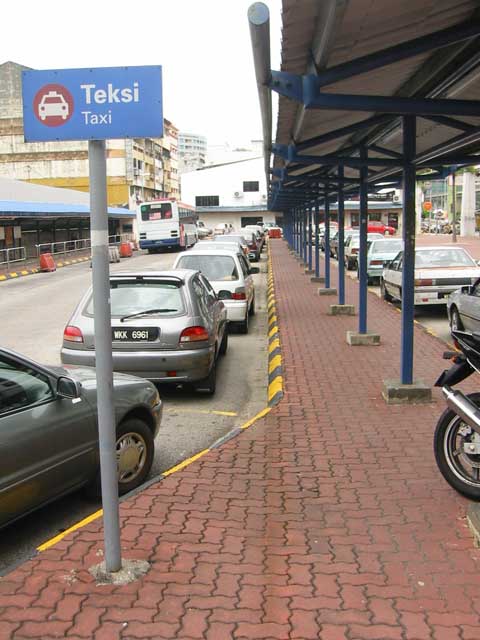
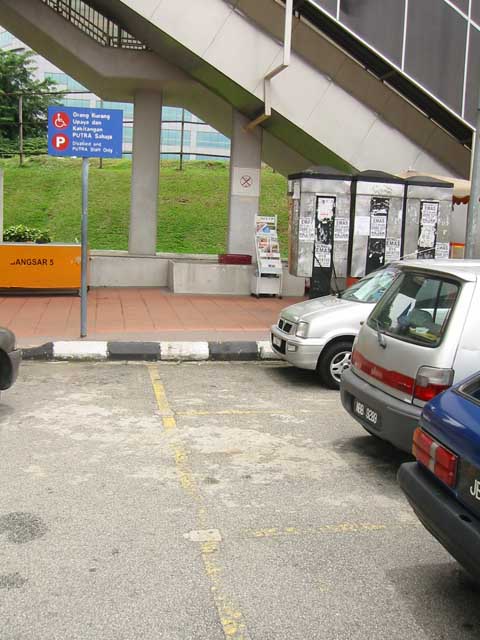
Kuala Lumpur Structure Plan 2020, by Dewan Bandaraya / City Hall
Saya sokong. But wait, is there a similar plan for Subang Jaya, Shah Alam, Klang, Petaling Jaya, Ampang Jaya, Gombak, Selayang, Kajang, Seremban dan lain-lain. The Klang Valley consists of more than just Kuala Lumpur. And we need a plan for the whole Klang Valley, not just for KL. What are the other Local Authorities doing?
But seriously, this 2003 plan could have been published in in the 1984. Who knows the same thing will be written in 2023?
I have said it many times, I don't really need to write much actually. Everything that needs to be done is already known. All the solutions are all waiting to be adopted. Plans have already been made.
Let's stop this curse!
Sunday, September 17, 2006
In the Dewan Rakyat, 23 April 1997
Tuan Lim Guan Eng [Kota Melaka]: Saya ingin bertanya apakah tindakan yang diambil oleh pihak kerajaan ke atas masalah ini kerana saya rasa kita harus ambil satu holistic approach bukan sahaja kementerian Yang Berhormat Timbalan Menteri tetapi oleh keseluruhan kerajaan. Kerana kalau kita gagal berbuat demikian ia akan membebani negara dan akan mengakibatkan kos yang agak tinggi ke atas ekonomi kita. Dan pernah pula ada satu kajian yang dibuat baru-baru ini bahawa kos kesesakan lalu lintas dianggarkan sebanyak RM25 bilion setahun. Kerana dari segi pembaziran masa, dari segi time management, apabila kita hendak sampai ke tempat kerja dan balik ke rumah kita perlu habiskan sekurang-kurangnya dua hingga tiga jam dari segi produktiviti, kerugian produktiviti dan juga kerja saya rasa itu adalah satu jumlah yang agak tinggi dan dianggarkan sampai tahap 25 bilion.
Kalau begitu, Tuan Yang di-Pertua, saya rasa itu bukanlah satu jumlah yang kecil dan saya rasa kerana ia sudah sampai ke satu tahap yang boleh di anggap sebagai satu krisis, kerajaan harus memeranginya dan menganggapnya sebagai satu krisis melawannya dan memeranginya dengan serius. Janganlah mengambil tindakan seperti sekarang an ad hoc approach, dengan izin. Kalau kita hendak mengatasi masalah kesesakan lalu lintas kita hanya ad hoc, mungkin sana buat sikit bus lane, sini buat bus lane tapi akhirnya kenapa ia sesak juga, kerana bottle neck yang sedia ada tidak di atasi. Sungguhpun ada bus lane tetapi bus apabila sampai ke tempat tak ada lorong bas lagi dia kena keluar, sanapun kena bottle neck. Ini tidak akan menyelesaikan masalah kesesakan lalu lintas dan untuk mereka yang memiliki kenderaan khususnya pelabur-pelabur sektor swasta terutamanya dari segi pengangkutan bila mereka hendak membawa barang-barang mereka dari satu tempat ke tempat yang lain, saya rasa ini melibatkan kos dan tidak boleh dinafikan sungguhpun lorong bas ada mempertingkatkan atau memperbaiki kedudukan untuk mereka yang menaiki bas. Tetapi untuk pemilik-pemilik kenderaan keadaan sudah menjadi lebih teruk di mana masa atau kesesakan yang sedia ada bertambah buruk dan di sini saya harap bahawa pihak kerajaan kalau hendak memperuntukkan satu lorong khas untuk lorong bas saya harap jalan raya yang sedia ada boleh dilebarkan. Kerana kalau tidak dilebarkan yang eight-lane highway, dengan izin, akan tinggal six-lane highway. Untuk kenderaan-kenderaan yang lain, kenderaan swasta saya rasa ini akan memburukkan lagi keadaan kesesakan lalu lintas. Baru-baru ini cadangan yang dibuat oleh Yang Berhormat Menteri Pengangkutan bahawa bangunan-bangunan tidak perlu ada tempat letak kereta supaya kita boleh mengatasi masalah kesesakan lalu lintas, saya rasa adalah dengan izin short-sighted. Tidak menerusi pertimbangan yang waras, yang cerdik kerana masalah kesesakan lalu lintas saya rasa bukanlah setakat tapak meletak kereta. Kalau bangunan-bangunan tidak dikenakan untuk menyediakan tapak meletak kereta saya rasa ia tidak akan mengatasi masalah kesesakan lalu lintas kerana pengangkutan awam yang sedia ada tidak memuaskan. Kalau ia amat baik, lancar, saya rasa rakyat dengan sendirinya akan menggunakan sistem pengangkutan awam dan tidak akan bersusah payah bangun pukul 5.00 pagi supaya boleh sampai ke tempat kerjanya pada pukul 8.30 atau 9.00 pagi. Inilah masalahnya bahawa sistem pengangkutan awam kita teruk sangat. Oleh yang demikian saya harap bahawa pihak kerajaan dengan izin take a holistic approach bukan secara ad hoc, sini baiki sikit, sana baiki sikit, selepas ini macam dengan izin putting patches here and there. Akhirnya ia tetap akan bocor you patch here, you patch there tetap akan bocor kerana akhirnya tidak boleh tahan juga. Oleh sebab itu saya rasa apa yang dicadangkan oleh pihak Yang Berhormat Menteri Pengangkutan saya rasa tidak logik dan tidak rasional langsung kerana dari segi ekonomi kalau tidak cukup tapak letak kereta, lain kali kalau ada pengusaha yang akan menyediakan satu tapak hanya untuk membolehkan orang awam meletakkan kereta dan saya rasa ini tidak akan mengatasi masalah kesesakan lalu lintas. Kalau kita lihat contoh Bangkok sungguhpun tidak cukup tempat letak kereta dia sesak juga, dia tetap sesak juga. So, masalah utama ialah dari segi sistem pengangkutan awam yang tidak memuaskan dan apa-apa sistem yang dipakai tak boleh jalan langsung. Macam Intrakota sebelum Intrakota diperkenalkan adalah digembar-gemburkan bahawa ia adalah satu sistem yang paling canggih, yang paling baik, yang paling maju, yang paling efisyien sekali. Tetapi apabila ia diperkenalkan, sama juga, lagi teruk ia makan duit penumpang
sungguhpun Kabinet telah mengarahkan bayar balik ...
Dato' Haji Badruddin bin Amiruldin: [Bangun]
Tuan Lim Guan Eng: Nanti sekejap, saya habiskan dulu. Sungguhpun Kabinet telah mengarahkan mesti membayar balik 10 sen kepada setiap penumpang, ia masih belum dilancarkan. Oleh sebab itu saya rasa ini menunjukkan bahawa, apa-apa sistem semuanya tak ada sistem. Macam kerajaan nampaknya tak ada sistem.
Dato' Haji Badruddin bin Amiruldin: Terima kasih, Tuan Yang di-Pertua. Tuan Yang di-Pertua, saya ingat Yang Berhormat dari Kota Melaka ini dia kurang arif ataupun tidak faham apa yang dinyatakan oleh Menteri Pengangkutan. Masalah letak kereta ini akan hanya kita implemenkan setelah kita selesai masalah sesakan lalu lintas iaitu dengan kita punya perjalanan, tidak ada jam lagi di sana dan di sini. Jadi Yang Berhormat tadi hanya menyatakan tidak boleh selesai dan tidak mungkin selesai. Adakah pihak Yang Berhormat pernah membuat cadangan untuk menyelesaikan masalah ini kerena pembangunan di bandar raya ini begitu pesat. Kita hendak pembangunan, kita hendak maju di samping itu pula kita hendak memudahkan lalu lintas di bandar raya. Jadi, kerajaan sudah berjuta-juta ringgit, beribu-ribu juta ringgit belanja untuk memudahkan lalu lintas di bandar raya. Jadi, adakah pihak DAP pernah memberi cadangan, kalaulah cadangan itu baik kepada kerajaan ataupun hanya mengkritik dan tidak pernah memberi pandangan. Terima kasih. Yang Berhormat setujukah tidak ni?
Tuan Lim Guan Eng: Saya rasa Yang Berhormat, kalau nak tunjuk pandai ini bukan tempatnyalah. Dan kalau nak cuba...
Dato' Haji Badruddin bin Amiruldin: Tuan Yang di-Pertua, jawapan, jangan dok kata tunjuk pandai, jawapan, adakah Yang Berhormat bersetuju pandangan saya?
Tuan Lim Guan Eng: Saya belum ada peluang untuk jawab, jadi sabar sikitlah. Kalau hendak sokong, hendak jack sikit Yang Berhormat Menteri Pengangkutan saya rasa ini biarlah kepada konco-konconya dalam MCAlah. Yang Berhormat tak payah susah payah buat kerja itu.
Hansard
Short term solutions to Komuter
Recently, KTM Komuter has been drawing lot's of flak. Very good.
On the solution to the problem of all Komuter and intercity trains sharing the same railway track, Roslan said in fact no trains would be running except for the Komuter service but the Komuter service would sometimes be delayed because of the long haul of intercity service.You know what, the solution is damn easy. Just stop the freaking long haul express train (probably not very full, anyway, there'll be lot's of standing room) and let Komuter passengers on board! Then let the express resume (its already late) journey and have it stop at major stations.
The Star, August 22, 2006
It's not really going to directly improve punctuality, but at least it can relieve the system of some serious traffic, reducing further delays.
Anyway, is more rolling stock going to be purchased for the Komuter? What/where are the details? When? They are going to extend the services to Batu Caves and Rasa, and services are going to be spread even thinner.
Managing failure
KTM Komuter services disrupted for two hoursA contingency rail replacement service needs to be figured out. This isn't the first time it has happened. It won't be the last.
KUALA LUMPUR: Power failure disrupted the KTM Komuter service for two hours on Thursday morning.
Service on the Subang Jaya-KL Sentral and Sentul-KL Sentral routes was stopped from 6.19am to 8.30am, causing many commuters to be late for work.
According to KTM Berhad corporate communications executive Shahriza Embi, the disruption in service at the two areas were caused by a breakdown of the “overhead line equipment”.
The Star, Thursday, September 14, 2006
Realistically, I can accept and expect these systems to fail once in a while. For valid reasons and not too often though.
But what happens to commuters then? Again, how about mobilizing school buses or having performance linked bonuses?
Integrated Networking
Additionally, it is really bad that not only are rail lines not physically integrated, even ticketing isn't.
At this point in time, everyone will probably start thinking about the so-called Masjid Jamek "interchange". It was already bad enough that in the past, the lines passing through were run by two different operators at two stations at two different levels.
Touch 'n Go was only available on what was then Putra. Thank God that it was then made available on what was then Star. The Putra monthly pass wasn't valid on Star.
And if buying a single ticket, you'd have to purchase another one at the interchange when changing. Sigh.
Then came Rapid KL that brought back some order. Passes were now valid on both systems. (But physical integration is still horrible though.)
One of the next big things that should be implemented is a fully integrated ULTIMATE pass. But under the current management-ownership structure of this fragmented system, it is almost impossible. Transport providers will not want to participate as there will be issues such as revenue sharing.
How would Rapid KL compensate these other providers when commuters use these passes on their systems?
Now, I am not suggesting that SPNB buy up ERL, KTM and KL Monorail and Rapid KL take up management to fix this whole integration mess. Far from it.
In other countries, different lines are sometimes also managed and run by different companies (such as Singapore's SMRT vs SBS Transit, or London's Metronet vs Tube Lines). Seemless ticketing integration has been proven possible in many places.
What I would suggest is that these other rail (ERL, KTM, KL Monorail) and bus (Metrobus, Selangor, Triton etc. ) operators still manage and own their own infrastructure and major operations, while Rapid KL take over ticketing, marketing and branding.
In other words, have Rapid KL enter a long term contract with these Other operators to provide transport services on behalf of Rapid KL. In return Rapid KL offers these Other operators an agreed fix sum every year, plus maybe a performance bonus subject to some KPIs. Incentives should also be alligned to encourage investment in more capacity and better systems.
Rapid KL would become the sole buyer from these Others, and Rapid KL would resell these journeys to the population. Passes can be used systemwide, being good for commuters. Tickets and passes would be the same systemwide.
A systemwide branding and corporate image can be employed. Bus services of Other operators can be controlled better. Transport literature can be better provided. Route numbers under Rapid KL's Areas should be extended for the Others.
Passengers ought also to be guaranteed a consistent (and GOOD) level of service and quality anywhere in the system, whether it is a SPNB network or that of Others. For example, regulating the quality of toilets, escalators, platforms, lightings, access, seats and air conditioning.
As mentioned earlier, bonuses should be performance based: for example breakdowns, punctuality and customer satisfaction. For buses, have operators tender competitively for routes.
It is possible to have a unified and integrated system, without having all of them under one management and ownership.
Mobilizing more buses
In the meantime, there are also other non-public transport buses in the Klang Valley.
School buses do their runs from around 6 a.m. to 7.30 a.m., in the mid day, and evenings. Excursion buses (bas persiaran) are unlikely to be used that early in the morning. While I have no idea when factory buses (bas kilang/pekerja) are used.
What I am suggesting is that these buses be mobilized to add capacity to the current network whenever they are needed, and whenever they are free.

For example, most school buses ought to finish their runs in the morning by around 7.30 a.m., or 8 at the latest. How about Rapid KL subcontracting these buses to do some trunk or express routes? Meaning having these buses do Rapid KL services, issuing Rapid KL tickets and accepting Rapid KL passes doing Rapid KL routes.
Since these buses are not really designed for public transport purposes, i.e. they only have one door in front, have a set of stairs to climb and have many seats but a narrow corridor, they are better used for longer distance travel.
So, why not use these buses to pick up passengers for trunk and express routes in addition to the current ones?
For example, the western suburbs (Areas 5 and 6) like Subang Jaya, Sunway, Puchong and the Damansaras are badly covered by the rail networks. School buses, after doing their school runs, can be used to ferry passengers right into KL or other urban centres, such as Pusat Bandar Damansara.
As for other areas, they can be used to temporarily relieve the demand due to the Komuter and LRT reaching its current capacity (until the new rolling stock arrive).
Or like how about having new routes from these areas head to the City via expressways like the NPE or Penchala Link to conduct express services?
It can be a little trickier in the evenings, due to school ending at the same time workers in the city return.
At least, making one part of the journey easier and less stressful is better than none, and especially if it's the one that's going to affect your mood for the rest of the day.
More examples


This is Michael Bloomberg. He is the Mayor of New York City. He travels to work using the subway.

This image above, obtained from the BBC, has the caption "Michael Bloomberg took the subway to work on Friday as usual".
(thanks moz monster for the info)
Meanwhile our politicians, policymakers and transport operators are probably so disconnected and unaware of what the masses have to go through. Many probably have their secretaries check their emails. I am highly doubtful that even this blog will reach them.
There is this story, some say a legend, where in 1992 George Bush (the senior) entered a supermarket. He saw a bar code scanner in operation and was thoroughly amazed. The press had it reported.
He didn't win the 1992 presidential elections. (Although I won't say this is a cause-effect thing)
Saturday, September 16, 2006
Examplary


This is Ken Livingstone. He is the Mayor of London. He travels to work using the London Underground.
And this is the real thing. Not some media stunt, ala OKT or Anwar Ibrahim before his fall. This is no Royal Train or ribbon cutting. Just Mr. Livingstone going to work, just like other Londoners.
Here is some evidence.
Wait, do you even know who your mayor is?
Some other interesting reading: Underground Etiquette.
Bus Stops - London
Actually I'm pointing out London because Transport for London has been utilising the same corporate identity that is probably as old as the system. You know: red buses, clean signs, clear fonts that looked cool in 1956 and 2006, no Times New Roman printed on photocopied A4s.
Bus shelters

It rains a lot in Britain. It also rains a lot in Malaysia. Moreso, the sun's brighter and hotter in Malaysia. We need bus shelters. Not just bus stops. Not just a pole sticking out of the ground on a patch of grass. Bus shelters. And make sure they are lit up at night!
Bus signs

Install these signs on polls high enough for people to see from far, and to let passengers already on buses spot too.
List down routes that stop here. Yellow routes are buy tickets before you board. N-prefixes are Night Buses.
Display direction of routes passing by.
Route information


Route information should be plentily available.
Bus route maps, and not just the typical ubiquitous Rail Map. Colour coded bus maps, detailing destinations.
Spider maps provide in depth information about this! This is an example of that from Blackfriars.
A map of the vicinity and/or neighbourhood, detailing landmarks and places of interest and also point out alternative places to catch buses in the vicinity
Electronic signs to provide real time information

No explanation needed.
Timetables


On busier routes, detailed timetables are not provided (because they can never be on time). But frequency information is given instead.
Escalator speeds

Step into a metro system in another city and you'll realize how ulu and pre-war our LRT and other rail sytems are.
Apart from ticketing, the first thing that one notices is our escalators.
Our escalators are just as slow as those at shopping centres. Probably these jokers were thinking that commuters would enjoy a breather before they board the packed like sardine cans LRTs.
In Singapore, the escalators at MRT stations are noticibly faster. Very much faster. And according to my Singaporean friends, they speed up the escalators even more during peak hours. Wow!

Meanwhile, while we struggle to climb up and down stairs at our newer-than-Singapore LRT stations, other transport systems elsewhere are continuing to invest and research better and more efficient ways to move people around. Sigh.
Meanwhile, look at what some of Singaporeans are already doing. Even bigger ~~sigh~~!!!
Let's get it right this time

Public transport, too
Let's not forget the less spectacular cases. Back in 1997, the bus companies of Kuala Lumpur were forcibly merged so that "public transport could become more efficient". On paper it sounded great. Under one consortium, busier routes could cross-subsidise the less profitable ones thereby improving services. Moreover, since we are a Maju Jaya country, we need buses that look new and shiny.
However, the reality was painful. On the first few days of the takeover, thousands of commuters turned up one or two hours late for work because Intrakota wanted to "optimise" (read: minimise) the number of buses that it had to provide. To add insult to injury, the ticket price was increased from 60 sen to 90 sen.
Three years later, commuters still have to stand and wait for Intrakota buses longer compared to the old mini-buses. And on top of it, the crony-controlled company is still whining about making losses (just like Parkmay, another crony-controlled forced consolidation of bus companies). How is it that mini-buses could provide a faster, more frequent and cheaper service and still make profits? What the hell is wrong with Intrakota?
The answer is self-evident. There is a parasite somewhere in the system sucking out money. There was also a conflict of interest, because Diversified Resources Berhad, the company which owns Intrakota, also wanted to sell more Proton cars. And since selling cars is more profitable than selling bus tickets...well what more needs to be said?
Khau See Kit, Malaysiakini, May 2000
http://www.geocities.com/seachange_2000/Pearls/colonised.htm
Please don't screw it up another time.
MyKad

From the National Registration Department
Touch ‘n GoAnd an FAQ:
MyKad facilitates your transportation needs. Functions like a Touch ‘n Go card. MyKad can be used for toll payments, parking fees, bus fares, LRT fares and theme park fees.
I have got a 64K chip MyKad but without the Touch ‘n Go Logo. How can I upgrade and where?And the most interesting thing from the website... a song!
You can apply new MyKad at any GSCs** counter.
From the north to the south
Beyond tropical east and west
The many cards we carry
Is getting too much heavy
Now comes a solution
A blazing revolution
It's everything in one
That's Mykad, oh Mykad is the one
MyKad for Malaysia
MyKad for the world
A door to the new frontier
MyKad just one touch to the world
It's kad akuan diri
It's got a personality
She's a license to drive
She's cashin' in on me
Your health records, or IC
A unique identity
All for one, and one for all
She's mykad, kad akuan diri
MyKad for Malaysia
MyKad for the world
A door to the new frontier
MyKad just one touch to the world
MyKad for Malaysia
MyKad for the world
A pride of our nation
MyKad just one touch to the world
(**Government Service Centre (GSC))
Friday, September 15, 2006
Compulsory Reading
I really don't have to write anything here actually. There is so much evidence available on the internet as to what a good public transport system is and how to go about making it work. So why bother writing it all over again?
As much as some people disagree about the reliability of Wikipedia, I still love it. Of course I am not going to cite it in my research papers, but it's an enjoyable read where obscure but interesting topics are explored and codified in a democratic way.
I will keep this page updated as I stumble across more interesting reads that will hopefully reach the Datuk Bandar or Rapid KL CEO or some YAB. No need for your expensive lawatan sambil belajar. I guess if these white collar big boys just leave the comforts of their BMWs, spend a little time reading this blog and others, and also reading some of the "suggested reading" listed below, we can bring our Sistem Pengangkutan Awam 20 years ahead.
What we have
Rapid KL WP
Touch 'n Go WP
What we should strive for
Rapid Transit WP
Singapore MRT WP
London Underground WP
London Buses WP
Singapore Bus Transport WP
Octopus WP
Oyster WP
EZ-Link WP
What we should consider
Road pricing WP
Singapore Area Licensing Scheme WP
Electronice Road Pricing WP
London Congestion Charge
Touch n Go - More Ideas
Variable discounts by time
With an electronic system, why not offer more discounts to commuters who travel off peak hours? It is possible to do it for manual tickets, but it will be confusing with so many paper based tickets to distribute.
Or to stretch this even further, with cameras and proper electronic ticketing, the system operators can estimate how busy the system is. If it is not very busy, they can throw even bigger discounts. Of course passengers should be reminded that when they use the system, they should expect to always pay full fare (minus concessions and fixed discounts for using TnG). But I'm sure passengers would appreciate the goodwill of the operators by offering even bigger discounts. This creates an incentive for users to travel off peak. Anyway, defining "off peak" can be quite troublesome at times.
Market research
With an electronic system, passenger travel data can be fully captured. Operators and planners can identify what are the more popular journeys being made. Unlike currently (if at all that is!) where they will just estimate how many people take Route 505, or enter Masjid Jamek at what time.
With this whole database of usage data, new routes can be planned and others altered.
Of course, in the case of buses, this means that passengers ought to tap their TnGs when they exit also, in addition to while boarding to validate.
Competition
Visa has their Wave. Mastercard their Paypass. They all work using RFID technology. Perhaps they are slightly different in their own ways, in complying with different technical standards.
But I'm pretty sure that there is a common technical standard that allows readers to read cards with different technologies.
The point of this is to introduce competition to Touch n Go. If you park using your TnG, you are probably aware of the 10% handling fee that is added to your normal parking charges. Essentially, stingy car park operators pass on the cost to you (which is counterintuitive actually, since running the Autopay machines may be expensive as there is the need to handle lot's of cash).
Or how about MEPS, the ATM network people, coming up with a competiting yet compatible system?
Or all this mobile banking, mobile money business. With these canggih-manggih phones, some with RFID, how about letting these transactions be billed to our monthly statements?
Well, the more, the merrier. But remember, the keywords are competition and compatibality! We have so many choices of credit cards, but essentially, they are supposed to be compatible all the time! Let's hope these jokers don't forget these.
Hopefully it will be as good as cash in the near future.
Itemised billing
How about offering FREE itemised billing and journey histories? Maybe letting users view them for free at ticket counters, ATMs, or online but having to pay RM0.50 to get it printed?
London's Oyster allows you to do this.
Privacy concerns
Some users don't like to have their names and IC numbers associated with their journeys. And undoubtedly, someone is collecting all these data. Whether it is being used for market research (as I would advocate) or for more sinister purposes (think 1984), I don't know.
So maybe we should allow interested users to buy it like how we used to sell prepaid telephone numbers? Of course, offer discounts for registration.
Mandatory usage
Manual paper tickets and traditional magnetic tickets are expensive. Plenty of labour has to be allocated to man counters, when these staff should be on platforms (and ready to evacuate stranded trains, especially under tunnels!) or at bus stops assisting passengers.
Carrying coins and notes are risky, as there is a lot of potential to make mistakes. Coin and notes based ticket machines have to be always emptied and reloaded to prevent the rosak or coins only situations. A lot of time is wasted waiting to purchase tickets, when the better alternative is to have them all prepaid and ready to use.
So I would suggest that TnG become the default and mandatory ticket on the public transport system.
Of course, bank notes and coins are still legal tender. Operators cannot refuse to accept notes and coins.
But we can minimize it by encouraging people to reload and buy their TnG's using credit cards, debit cards and bank accounts, from ATMs, cashless ticket vending machines, banks, ticket offices and online. Throw in a rebate if they pay in certain preferred modes.
Additionally, for the LRTs and rail services convert all single tickets to RFID based tickets and discard all forms of manual tickets and magnetic insertion tickets.
In Singapore, transport fares are higher when not using their EZLink. On the MRTs, their Genral Ticket Machines do top-ups for EZLinks as well as selling single tickets.
These are some of my lain-lain ideas that I have thought of while being inspired by the success stories of EZLink, Oyster and Octopus. I hope TnG, transport operators, retailers, banks and the government read this and get all excited!
Touch n Go - Lessons from Hong Kong
I haven't been to Hongkong, but I've read quite abit about its Octopus. Let the plagiarised Wikipedia do the talking.

Contrast Hongkong's Octopus with our TnG:
More widespread use
Making payment at convenience stores, supermarkets, fast-food restaurants, on-street parking meters, car parks and many other point-of-sale applications (e.g. service stations and vending machines)... and at many stores in the city, most notably, 7-Eleven, McDonald's, convenience stores, other fast food restaurants and Starbucks coffee shops.
A large number of vending machines and self-service kiosks in Hong Kong accept Octopus as payment; these range from beverage vending machines to payphones and photo-booths — they can even be used to purchase travel insurance (for HK$10 per person, from the Bank of East Asia). Ricoh, Minolta and Fuji Xerox offer photocopiers that support payment by Octopus.
Other applications
In addition the system is used for access control to offices, schools and apartments. It can even be used to donate money to charities.
What can our MyKad do? Not that we trust the government anyway.
Easy reload
Cards can be recharged with cash at add-value machines or over the counter in shops (notably 7-Eleven and Circle K), or directly through credit cards and bank accounts.
It doesn't say some credit cards. Nothing about paying RM1 (50 sen?) at the ATM. Nothing about, only available at certain stations up to 10 p.m.?
Concessions
Concession users are also acknowledged by a higher pitched beep on all forms of transport barring the MTR, which plays three notes in succession.
To avoid abuse of concessions.
Discounts
MTR and KCR charge less for journeys made using an Octopus card compared with using single journey tickets. For example, the cost of a single journey from Chai Wan to Tung Chung is HK$23.1 with an Octopus card, and HK$26 with a single journey ticket.
And we pay more to use our TnG for parking. WTF! WTF! WTF!
Loyalty Marketing
Octopus cards can also be used to earn various kinds of rewards. In the past, passengers could earn "MTR Points" for their rides on MTR to redeem collectibles or free single-ride tickets. Now the Octopus Cards Limited has also launched an Octopus Rewards scheme, enabling citizens to earn reward points for every purchase in designated shops by a ratio of HK$200 = R$1 (reward point).
Deposits and refunds
Deposit and the remaining value on the card are fully refundable, except for a HK$7 administrative charge for cards refunded within 3 months after issue. (For personalised cards the charge is HK$10, for cards issued after 1 November 2004 or those refunded within five years of issue.)
Taxis
On 27 June 2006, the first trial of taxis equipped with Octopus was launched in the New Territories with the Yellow Taxi Group and widely welcomed by the public and the local press.
International use
MTR has signed an agreement with the developer of the Shenzhen Metro's automatic fare collection system towards making Octopus cards compatible with the fare collection system in Shenzhen Metro, which would require that the systems automatically convert fares denominated in Renminbi into Hong Kong dollars.
Of course there will be a few xenophobic racist policymakers won't let this happen.
Touch n Go - Good news
"Currently, the tickets are still manual, but we will be introducing Touch N Go cards by end of the year,” said Mohd Ali.
Touch n Go - Lessons from London
It also has a really really really old public transport system. The London Underground started services in 1863. That's probably earlier than civilized KL.
Anyway, after putting much thought to it, from my experience observing a few public transport systems around the world, I would like to suggest the London way. Not because it is really superior in all ways, but because I think it is a good working model that balances private and public ownership of the system.

Here, I am going to focus on London's Oyster system.
London's Oyster Card is like Touch n Go. In fact, according to Wikipedia, both platforms use the same platform - Philips MIFARE. Thus, there is no good excuse for these buggers to say that the TnG can't do this and that because of technological limitations.
If you want to do any serious travelling in London, it is really much more value for money to travel using a pass (or Travelcard). Different passes, at different prices are sold to allow unlimited travel in specified zones, specified hours, specified periods and on specified systems. It's sort of like Rapid KL's passes.
(Travelcards allow travel on all Transport for London systems.)
Traditionally, bus passes and Travelcards used to be issued on paper tickets. Much like KTM Komuter tickets, with the words TRAVELCARD and dates, zones etc. printed clearly on them. On the tube, you just slot it into the turnstile. On buses, just flash it at the driver/conductor (and more often than not, they don't read it).
Naturally, single fares and prices of these passes and Travelcards were structured in ways that would encourage commuters to use the latter options.
In 2003, Oyster was introduced to London. And technology allowed Oyster to do greater things than paper.
Capping
Capping is probably the most interesting and useful thing about the Oyster.
Here I am going to explain how "capping" as used by Transport for London can work for Rapid KL. Specifically, I am going to explain it in the case of buses, since Rapid KL has revamped the whole system, especially with regards to pricing.
Under Rapid KL's new bus network the closest thing to a single ticket that is issued are day passes. There are four types of buses, and thus four types of passes issed:
- Local - services the suburbs - RM1
- Trunk - connects the suburbs to the city - RM2
- City - services the city - RM2
- Express - long distance travel - RM4
- Comprehensive - Local + Trunk + City - RM4
- Ultimate - Local + Trunk + City + Express + LRT - RM7
Suppose that instead Rapid KL issues single tickets with the following prices (assume we divide the passes by 2)
- Local - services the suburbs - RM0.50
- Trunk - connects the suburbs to the city - RM1
- City - services the city - RM1
- Express - long distance travel - RM2
With capping, passengers would just pay for what they use under a certain specified limit. In the case of the current bus system, it should be RM4. So while I make as many journeys in a day below RM4, I will pay for what I travel. But the minute my usage touches RM4, it is capped, and I won't be charged for any other bus travel for the rest of the day.
Isn't that a more equitable solution?
Obviously, this can never be done with paper based tickets that are inspected and verified by sight. An electronic RFID system like TnG can allow this to work.
Rapid KL can figure out a pricing system for the Ultimate for themselves. What I would suggest is to either lower prices for all tickets and passes using TnG or raise them for paper ones. Issuing paper tickets is costly, and I have already talked about fare evasion, which is a problem with manual tickets.
In fact, in London, sometimes you can see junkies begging for used Travelcards at the end of the day, and some of them will be seen selling them away. An electronic system such as TnG can enforce this non-transferability, to a certain extent (e.g. lending your card to your mom).
But the bloody card costs...
Now, we can go on banging TnG for the charges fixed on first time users to purchase cards.
Actually, most of us who don't claim to own a TnG already do. We all have MyKads. And MyKads have the TnG component embedded into it. So the infrastructure is already available, the masses are already tech compliant. All we just need is for Rapid KL to make this work.
Wednesday, September 13, 2006
Touch n Go - why it is soooo bad

The credit card sized Touch n Go can be the perfect solution to all our ticketing troubles on KL's public transportation network.
But why doesn't everyone want to use it?
According to the Touch n Go website:
Customer needs to fill in an application form at Touch ‘n Go Sales counter. The card costs RM10 each and comes with a one-year warranty period.
(Ah. Look at that arrogance. One year warranty. If you read the Terms and Conditions, they will say that the card is the property of TnG or whoever. So if it is spoilt, they should replace it right? Even banks and credit card issuers do that!)
The card costs RM10 and you need to fill up a form. The RM10 isn't a deposit, by the way. The RM1o belongs to TnG rightafter. Why should users pay for this RM10?
Surely, they will say that it is a service, so it gives convenience to users etc. Bollocks. Some credit card companies can give out cards with no annual fees. Why can't TnG?
Once you reload the TnG, the credit is safeguarded by TnG. It's like a bank. You put money into the bank. But the bank compensates you for the loss of liquidity by offering you interest. Why can't TnG do that!?
Then there really is no other benefit from using TnG in terms of prices. Did you know that users of Singapore's EZLink and London's Oyster pay lower ticket prices that those who pay cash? Hell, many parking operators force a 10% surcharge for the use of TnG. Wtf. Where is the incentive for commuters?
Everywhere around the world, merchants and transport operators know that in the long run, it is more cost effective and customer friendly to use cashless systems. As I mentioned earlier, counting coins and notes and moving them to and from the bank is not a nice or safe thing to do. That's why although the payment systems operators (like Visa, Mastercard, MEPS, Oyster, EZLink) charge the merchants a commission, they realize the value in the service. Similarly, customers like to collecting points and the convenience of not having to touch icky yucky bank notes that were probably once handled by a butcher.
Also, Touch N Go isn't available systemwide. It is available on KTM Komuter, KL Monorail and parts of Rapid KL. Evidently, it is not always available on buses.
There are also the many reported cases of card readers at station barriers not always working. This means sometimes users are forced to pay penalty fares.
Credit decution is also hardly transparent. Displays on card readers at barriers are typically old, so users can't read how much is deducted on a journey. And worse still, many at times, the card readers don't make any beep. How would users know if the transaction went through? And how about itemized billing? Why do users have to pay extra for that?
Those are the complaints. In the next posts, we will see how other transport systems make it work, and how we can make KL's TnG work too.
Common Ticketing System?
Fair enough. They were installed, but not enough were installed, and they were in typical Malaysian fashion always rosak.
Either it was plain rosak, or it'd eat up our money, or it was coins only.
Rapid KL (and what was then Putra) started issuing manual tickets. You know, like those issued during our primary school Hari Kantin?
Wow, we supposedly had a a first world, Wawasan 2020 world's driverless automatic light rail whatchamacallit, and we had erm.. a third world ticketing system, ala Syarikat Kenderaan Sri Jaya.
So among the many questions I would like to pose to the authorities and many transport operators, not exclusively Rapid KL:
- Where is this supposed "common ticketing system" that you all have been talking about for years?
- In the 1990s, had you all even considered the idea of a "common ticketing system" before you bought your ticketing systems?
- Why are your ticket vending machines so rubbish, so much so that they are always out of order or do not accept notes?
- What about your alternative ticket systems? Like the manual tickets - how sure are you that passengers are not evading full fare with these?
- How long are you expecting to let this pathetic system remain?
- What are your plans then?
- Passengers waste plenty of time queing up for tickets. Especially when they have to repeat the process when they switch to another line.
- Valuable manpower assigned to issue tickets could be better utilised on platforms to manage passenger traffic.
- It is costly to handle cash, especiall coins. You have to employ armoured vehicles ala Securicor to move them around and banks hate doing coins and small change. Anyway, banks have better things to do than doing coins and small change.
- It is so easy to evade fare under the current system.
- An opportunity to collect passenger travel information has been lost.
There are day and monthly passes issued by Rapid KL. But it is not systemwide. And it doesn't address all of the concerns mentioned above.
There is also the Touch n Go. Come to think of it, Touch n Go, being electronic, contactless and has the potential to be used in an multi-application environment appears to be a way out of this mess.
But why how many people actually use Touch n Go for their public transport needs?
This, I will discuss in the next post.
Huru-hara
And I know how random, disorganized and unstructured this blog has been, and will remain to be (well not as bad as the KL Public Transport System itself though). But you know, it's really frustrating, and so this blog's a place for me (and you) to let off some (constructive) steam.
The system is so bad, that sometimes we don't know where to start. So why not just start banging the system from all angles, and then offer constructive advice?
Maybe once we have enough ideas codified here, we can structure it by perhaps doing a Wiki?
Underinvestment
(By the way, I am anti fuel subsidy. Why should the whole country pay for the wasteful lifestyle of moving around heavy metal cages when other more cost effective methods are denied support? Anyway, Economics 101 tells us that global oil prices are up, and the most efficient response by the government is to let prices at the pump rise too.)
I am not the person to discuss these different methods of public finance. What I am trying to say here is that, where there is a will, there is a way.
I am too lazy to dig up the amount of money spent on roads as compared to rail infrastructure in Malaysia.
But head over to the Malaysian Highway Authority's website and look at the list of highway projects:
- Shah Alam Expressway
- North-South Expressway Central Link
- Sungai Besi Highway
- Cheras - Kajang Highway
- Damansara - Puchong Highway
- Ampang - Kuala Lumpur Elevated Highway
- Lebuhraya Penyuraian Trafik KL Barat - (SPRINT)
- Lebuhraya Baru Pantai - (NPE)
- Lebuhraya Lingkaran Penyuraian Trafik Kajang - (SILK)
- Lebuhraya Koridor Guthrie (GCE)
- Lebuhraya Khusus KL - KLIA
- Stormwater Management and Road Tunnel (SMART)
- Lebuhraya Duta - Ulu Kelang (DUKE)
Contrast that with the rail networks:
- Kelana Jaya LRT
- Sri Petaling and Ampang LRT
- KTM Komuter
- KL Monorail
That's 274.6 km of concrete and steel track. (I was contemplating adding the Bandar Sunway Monorail - he he he).
(I am not anti car. In fact, I drive, and I enjoy driving. But there are many many times when I am forced to drive, when wish I didn't have to, In fact, I am just pro-choice. Having more choice in my mobility.)
How much more track will be laid following Najib's August announcement?
If it was so easy to raise finance or find businesses that are willing to take the risk of operating these highways, why not rail infrastructure?
My guess? Highway construction and operation isn't as high tech as that with rail (except the SMART tunnel or KL Monorail maybe, he he), so the local boys realize that it's only possible to do their Ali Baba senang makan ways with highways. With rail, they'd have to invite all the orang putih and Japanese in, and then Ali Baba can't dirty his hands anymore and will have to start eating with chopsticks and fork/knives.
And then compare how much our neighbour, Singapore, is planning ahead and spending on its Circle Line and others.
Tuesday, September 12, 2006
Journeys to the west
Everyone knows that the KTM Komuter is always packed when you need to use it. And KTM is probably going to take quite some time to purchase new rolling stock (if ever).
I have looked at the new routes. There's something sorely missing.
So what I suggest now is that on September 23, Rapid KL will also introduce a Trunk or Express service that plies the NPE between Subang and KL, in addition to its current plans.
This service can spread out some passenger traffic from the already overused KTM Komuter. How about having the service start at somewhere in USJ / KTM Komuter and then move down the NPE pass Bandar Sunway and then pass Pantai Dalam into Jalan Bangsar before terminating at Sentral?
This route is almost parallel to the current Komuter, and it bypasses the busy Federal Highway?
But I guess it's a problem because Rapid KL won't want to pay toll charges to NPE.
Terribly underserved

The ubiquitous Rail Transit Map gives the appearance that the Valley is well served and covered.

Well with Google Earth, we can now have a much clearer view of how we have fallen behind over the years in leaving parts of the Klang Valley terribly underserved by these mass people movers.
The southwest corridor of Subang, Sunway and Puchong looks pathetically uncovered.
The nortwest area of Damansara, north Petaling Jaya and Bukit Lanjan is strangely empty.
In the north most of Setapak, Gombak, Wangsa Maju, Selayang and Batu Caves are far away from stations.
In the southeast, again, most of Cheras and Kajang are too far away from the arteries.
I don't have to show you what Shah Alam and Klang look like.
Thank Allah that Najib has just recently announced extensions and new lines in the Damansara, Subang Jaya, Puchong and Cheras corridors. Whether the announcements were just an aftertought due to the shit going on in UMNO or the increasing loudness of grumbles due to rising prices is for another time and place.
Even then, I don't think these extensions are enough. Many areas would remain underserved, like Kepong, Shah Alam, Klang, Setapak, Batu Caves and Selayang.
Admittedly, not all areas can be covered, due to land scarcity and the costs involved. But as long as they can continue to find the land and resources to construct expressways and not mass transportation systems, we know they are just bluffing.
Kebodohan terlampau
Many of you riding the Kelana Jaya Line, or what used to be called PUTRA LRT, would realize that almost noone gets in and out of Abdullah Hukum station.
Kg Haji Abdullah Hukum is actually a squarter village squeezed between Jalan Bangsar, the railway lines to Seremban and Klang, as well as the Klang River.
Only God (and the greedy policymakers) know why the LRT was alligned to stop at this squarter village and not Mid Valley, across the river.

I can only conjecture that in the 90s and late 80s, there were plans by some greedy and well-connected developer to bulldoze Abdullah Hukum Village and turn it into some development - probably ala Mid Valley itself. And so, this fella who thought he could buy Abdullah Hukum cheap and have the Federal Government subsidize access into his development would make millions.
But history has shown that this archetype businessman has failed, because there is no development in the area (apart from the flats).
Praise the Lord, that somewhere along the way, some "visionary" at IGB, DBKL or KTM decided to build a station along the KTM tracks. Well I still don't know why it took them so long to figure that out.
Credit should also be given to IGB, by providing free bus services to Bangsar LRT. There is nothing much they can do about a misplaced LRT station.
However, I would suggest that as the Mid Valley development inches closer to the Klang River, especially with the Garden Mid Valley (yes!!!!), they acquire the land (and permits) to construct a fully air conditioned passenger bridge to link Abdullah Hukum to Mid Valley.

That's a 250 metre journey, but hey, the Megamall is almost 400 metres long.
And let me advise in advance: Make sure it's airconditioned and include lot's of (fast) travelators. And how about creating more retail space? Like Singapore's CityLink mall? Or those at Orchard MRT? Not like KL Sentral's pesta ria okay?
Missed connection

KL Monorail has got it all wrong, all over again.
When KL Sentral was opened to the public in the late 90s, I struggled to look for what would have become the KL Monorail's platform.
Lo and behold, a couple of years later, we see a street in the midst of pawn shops and blind masseurs boarded up to build a station. No, this wasn't in Sentral's grounds. From Sentral, it was across a giant car park and a Jalan Tun Sambanthan.

Using Google Earth, I have calculated the distance between these two stations: 140 m. Honestly, that isn't very far to me. But it's what in between these two that really annoy passengers.
Well let's do some reminiscing:
When the KL Monorail first opened, there was no covered walkway between the two.
A few months later, a covered walkway was built.
Recently, they have assembled tents on both sides of the covered walkway. (The Google Earth picture shows the tents on one side.) Tents to turn this covered walkway into a souq!? Now doing a change involves walking through this crowded covered bazaar, probably worse than attempting to walk Petaling Street.
It is poorly ventilated, smelly and crowded.
And that's why they probably have to offer this "feeder shuttle service".
I once had the honour of taking the Monorail on a rainy day. As I arrived at KL Sentral (MONORAIL!), it started to pour. The station entrance didn't have enough shade. There were parts which were shaded but were collecting water. Crossing over to the nearby pawn shops was difficult because there wasn't enough shade and the tiles were slippery.
Commuters wishing to cross to Sentral had to wait for the rain to momentarily subside, hope that the pedestrian crossing goes green at the same time, dodge puddles of water, cover their heads and dash over to Sentral.
I asked the Station Master: Kenapa macam ni? He replied that the car park was going to be developed.
And so? KL Monorail didn't manage to negotiate space for a station with this developer? KL Monorail has the right to label this station KL Sentral for the time being? Commuters had to put up with this shit for the time being?
Ladies and gentlemen. Here, we are witnessing Malaysian incompetence, indifference, greed and corruption of the highest order. A bloody big mistake has been made, and there is a bloody good chance for the mistake to be corrected.
But no, no correction. All we get is a shuttle bus and a souq.
Fare jumpers
Well, I don't think this is news. Everyday, many users evade fare through many ways.
Take for example the LRT services. When you purchase a manual ticket, how often does your ticket get checked when you enter the system (at the gate) and when you discard the ticket on your way out? There's nothing to stop you from purchasing the cheapest fare and using that ticket to travel.
Sometimes, there aren't any officers at the gates!
When Rapid KL issues manual tickets, shouldn't it also conduct random ticket inspections on the platforms and trains then?
Well, why issue manual tickets in the first place! What has happened to the ticket vending machines? What has happened to the common ticketing system? We'll discuss this some other time.
When buses are full (because standing commuters refuse to move all the way to the back of the bus), drivers sometimes allow passengers boarding to pay at the front and enter from the back. This being Malaysia, there will be passengers who would just board without paying.
I've noticed that this had become a norm. So, one day, when I was riding a packed Triton 309 (I think) at Pusat Bandar Damansara, I managed to correctly identify a fare dodger. I contemplated whether I should tell off that uncle. This being Malaysia (again), I would expect him to give me the typical cock-stare and other passengers would just mind their own business.
I was bloody sure of it, so I told him politely, "Uncle, you haven't paid your fare yet. It's not fair for you to do that." Naturally, he denied it. Argh.
But then this other passenger then said "Yes uncle. It's not fair. Please leave the bus." Har har. He was then forced to pay his fare, where he got all the other passengers to pass the money to the front. If I was nasty enough, I would have demanded him to leave the bus, as there were many others who couldn't get on.
So, what's the lesson here? Commuters, please pay what you use. And please fill up the back of the bus or middle parts of train carriages. Operators, I thought you were better at collecting what's due you.
Speak louder
I encourage all readers to complain, rant, make suggestions and praise the system.
Leave comments in appropriate blog entries. Or complain in this entry. Or write me at klcommuter@gmail.com.
Thats:

Please be specific and always give credit where it's due.

Complaining doesn't take us very far. But at least it is the beginning to a solution. The first step of problem solving is identifying the problem, no?
At any rate, the burden of fixing things falls on the service providers, not us paying customers.
Still, we are willing to help.
It will never work until...

Do these people even know how to use this bus service?
Public transportation will never work until the people who actually have the power to shape and control it use and understand it.

Best nya naik bas dengan suit Hugo Boss kita ni.
Every couple of months, we have politicians and civil servants exhorting the population to use public transportation or promising us with new extensions and upgrades.
It will never work.

Eh, ini Putra Line ke? When do I disembark for Wisma MCA then?
Hell, Ong Ka Ting riding a LRT with an entourage isn't what I mean. Naming a train the Royal Train after the Agung has rode on it once does not count either. Getting the Prime Minister to launch a service - no. Having the Deputy Prime Minister promise upgrades and extensions - not enough. Having a CEO of a transport operator covering up a problem of his companies by accusing commuters of being impatient - bloody no.

All the King's horses and all the King's men couldn't fix the LRT all over again.
Until these people actually taste what a stalled LRT with no airconditioning somewhere between Kampung Baru and KLCC at 6 p.m. feels like, they can't and won't do anything. Until they realize what it takes to cross a flooded Jalan Tun Perak, they don't understand us. Until they have to wait in the hot sun or soaking rain for a bus that hasn't appeared in an hour along Jalan Semantan, they haven't tasted no public transportation.
Until they leave behind their Perdanas and BMWs with the essential police outriders, will they not understand what we go through. Until they leave behind their press corps when they travel, will they not see what we actually go through.

Ke....lang... klang klang klang klang klang. Mari adik. Klang klang klang klang...
So, I exhort those in the corridors of power, those in high offices, those with huge budgets, please do something out of the ordinary (actually very ordinary), by trying the Sistem Pengangkutan Awam Lembah Kelang for yourselves one Monday morning.

We're riding the NICE bus!
Moving Forward
There are 3 parts to it, but I am embedding only the last 2 because I think we all don't need any introduction to this PROBLEM.
I hope the people at Rapid KL, DBKL, MBPJ, MPSJ and the Federal Government are watching this.
Interested in watching Part 1?
"Moving forward : towards better urban transport" gives a brief introduction to some of the isssues related to modern urban transport in the 'global South', with a focus on Southeast Asia. With footage from Burma, Malaysia, the Philippines, Thailand and Singapore, this documentary outlines problems associated with transport in cities. It also introduces some of the key tools to tackle these challenges, and make urban transport safer, cleaner, healthier and more people-friendly. Credits: Produced in 2000 by the SUSTRAN Resource Centre (Malaysia) for the SUSTRAN Network, with the assistance of the Southeast Asia Regional Canada Fund. Produced and directed by Zaitun M. Kasim and Paul Barter. Video concept by Paul Barter, Tamim Raad, Zaitun M. Kasim; editing by Neil Felix, Pusat Komunikasi Masyarakat, Kuala Lumpur, Malaysia.
Hello
Despite all the talk and so-called major leaps by the authorities, every resident, worker and visitor to KL would agree that we are nowhere nearer to the many masterplans that these authorities have drawn up for donkey years.
So, what gives? It's obvious that town planners and transport operators know what to do. They have their masterplans and press announcements. Obviously, the city and the authorities are either stupendously dumb, grossly corrupt or plain indifferent.
We shall use this blog to expose all the misdeeds and inaction of everyone responsible for public transport in the Klang Valley - including we commuters ourselves. It is everyone's fault that transport sucks.
I give credit to the authorities (and thei well paid consultants) for drawing up visionary plans. But we all know that things always don't come out as they should. So this blog will be used to point out the misimplementation of these ideas.
Additionally, this blog will be used to suggest ways to improve the system. I don't want to be (only) accused of being a complainer. Anyway, I bet, we users of public transport have many better ideas than these Perdana driving civil servants.
This blog is dedicated to the public transport users and pedestrians.